
Recently Google published a study touting that its new medical large language model (LLM) was heading towards "expert-level" medical question answering. It was able to answer most of a standardized medical test correctly (the USMLE). And after reading the paper I think I'd probably agree: That bot can answer some multiple choice questions! Many that I probably can't anymore. It is a really good... med student.
And this is not meant as an insult to med students — I was one once, after all — but that's really the point: medical students are on their way towards becoming a doctor — but they're still far, far from expertise. There's a reason that you graduate your 4 years of medical school and go on to your 3-9 years of residency: humans' medical questions almost never present with pre-determined multiple choice answers.
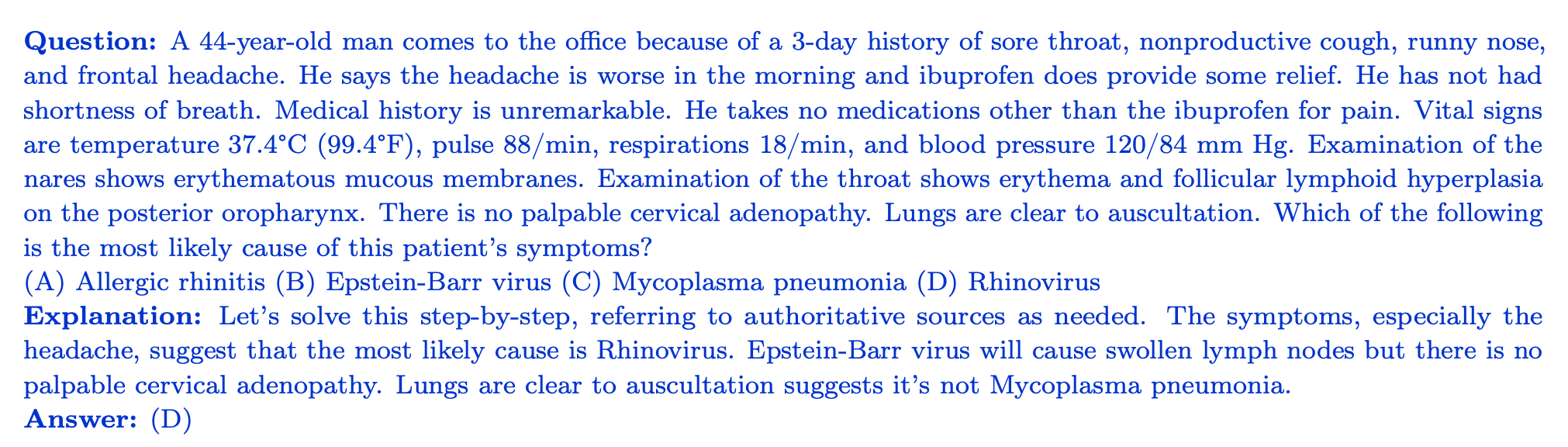
Let's take one sample question, from the actual paper:
Patients do not generally care which virus they have.
Congrats and correct, LLM: it was a Rhinovirus!
Even in this very clinically-relevant question, there is not even a tinge of the art of medicine. I can tell you several things about this 44-year-old man — whom I see every single day in the ER and Urgent Care: he does not care that he has a rhinovirus infection; he does not care if I know he has a rhinovirus infection. He cares about the fact that he feels crummy for 3 days and wants to feel better; he may think he needs antibiotics because he has a sore throat; he may conclude that if I examine him too quickly I'm not taking his problem seriously; he may be worried because he's missed 3 days of work and has no sick days; he might have a newborn at home and worry that he's going to get her sick. (Spoiler: I actually think there are a lot of ways that the LLM can help me with this patient; keep reading.)
Even still: I actually find these medical LLMs extremely promising, and I view them with (very cautious) optimism. I look forward to working with them and incorporating them into my medical practice as an emergency physician, just as I enjoy working with medical students and residents as well. I really think these LLMs can help me with the most challenging parts of my day, and with rigorous oversight, testing, and validation from clinicians like myself, they'll be absolutely indispensable to me.
Trust Me, I'm a Doctor
Contrary to what a lot of people think, most of the time, most doctors kinda know what to do with a particular patient with a particular condition, issue, or problem. I'd say it's probably 80-95% of the time — and that's due to a couple factors:
-
Doctors have to do a residency which is 3-9 years in their specialty, so they can see enough patients with enough diseases with enough variety in symptoms and response to treatment that they have a pretty good idea for how to handle most things.
-
Doctors break themselves up into specialties, so we don't have to know everything. Sure, in the ER I have to know a lot of stuff about every specialty and every age group — but ultimately I'm not making a final diagnosis in every single patient, and I'm not doing their surgery, or their colonoscopy, or taking care of them in the hospital. Similarly, if you twist your ankle, a cardiologist might know to get an x-ray, but might not be great at reading the x-ray or knowing which splint to use.
-
Common things are... common. Most patients have problems that we've managed before — and often manage every day. And while it might be the first time the patient has had X issue, it might be a standard issue for a particular specialist.
This is all to say that most of the time, I don't think I'd even ever consider using a "Medical Knowledge Bot" with most of my patients. (Famous last words, I know.) But generally: the management of a twisted and maybe-broken ankle is not going to change overnight. A chatbot is not going to help me with that patient's problem. Nor a patient with classic symptoms of appendicitis, nor a kidney stone, or kid who put a lego up their nose.
Help Me, Medical Large Language Model, You're My Only Hope
But now let's get to the meat and potatoes: where would I love some help? Let me count the ways:
-
When I don't know what to do: Sometimes patients have symptoms of a few different diseases with very different management and workups. For example, one disease might need ibuprofen for a few days, and the other might need to have emergency surgery, yet have the exact same symptoms. (Frustratingly there are quite a few disease like this.) Right now when this happens, we end up doing more tests to try to help differentiate the two. Tests are costly, time-consuming, and not-without-risk. I look at these LLM tools like any other tool we have come to adopt in medicine: a CT scanner, a blood test, an EKG. All of these tests help us figure out what could or could not be going on with a patient (when used correctly.)
-
When the patient doesn't believe me. Take our sample patient with a cold from the question above: it is extremely common that some tension develops in that encounter: the patient wants/expects that they need antibiotics for their viral infection. Or that they think it's strep throat. Or they Googled and think they have Lemierre's syndrome. With a well-trained and safe LLM model, I could see the tool being a helpful "second opinion." Patients will be pretty comfortable with them — since they'll be using them in their daily lives as well — and I could see an LLM saying "This patient likely has a viral infection that does not require antibiotics" — and the patient maybe trusting it because it's "objective." (Again — I can't reiterate enough that these systems require expert training and validation by practicing expert clinicians — lest these LLMs just become the "Dr. Google" problem on steroids.)
-
When the patient has additional questions. I love nothing more than to help explain what's going on in a patient's body and describe the plan I've come up with in detail. It helps them understand, it eases anxiety, and helps reassure. But have you ever felt rushed by your doctor — or if you're a doctor, have you ever been rushed? (As an ER doctor, my default mode is rushed.) Imagine an LLM that could provide medically-accurate discharge instructions, and answer every single question that a patient has about their bowel obstruction and the plan, the reasons why their doctors are recommending X or Y but not Z, or why their sodium level is 134 when normal is at least 135. I would virtually hug and kiss a digital agent that could help me do that.
-
When I'm heading in the wrong direction — or the patient is. Sometimes doctors head in one direction with a diagnosis or plan but either the tests aren't really matching up with said diagnosis, or the patient is getting worse in some way. It might be that what you thought was a pulled muscle is getting worse — or the patient gets a fever, or becomes short of breath or something — I'd love an advisor to politely butt (just like any great ER nurse does) and say, "Hey Graham, you, uh, sure it's just a pulled muscle? Come take a look again." One research paper has suggested that if the ER thinks a patient has a certain condition and they're wrong, it takes the hospital doctors several days to course-correct.
-
When the patient's not sure where to go for help. Let's be very clear: our healthcare system is confusing and opaque and obtuse, and it's every day that I see those consequences: patients show up in the ER because they don't know what else to do, where to go, or how to get help. And while I'm absolutely proud of my specialty's dedication to helping anyone, with anything, at anytime — I'd love to see a healthcare wayfinder that can (safely!) point people in the right direction — especially in areas where the ER is a poor fit for their needs.
-
When the doctor or patient doesn't understand evidence-based medicine and medical testing limitations. I won't go into too much esoterica, but please just accept this terrible, miserable, no-good medical fact: There is no perfect test in medicine. We are always balancing trade-offs of a test being extremely good but highly invasive and another test being pretty good but sometimes falsely wrong or falsely right. Essentially — if you have a really rare disease, even with an extremely good test — most of the people who have a positive test don't have the disease. Here's a great math-y Youtube video that explains it. I think these LLMs (which already understand these concepts) could help explain to patients why a test is or isn't indicated or recommended, or what to do when a particular test comes back normal or abnormal.
My Sidekick Extraordinaire
These LLM tools and other AI tools that will join them — are just that: tools. We know in medicine that any of our tests or tools used inappropriately will lead to patient harm, and I think we should treat these with just as much trust as any other test in medicine. It's their ease of access that will make them the most open to misuse (by doctors and patients alike), which is why it's so critical that they're tested, validated, and audited for accuracy and safety.
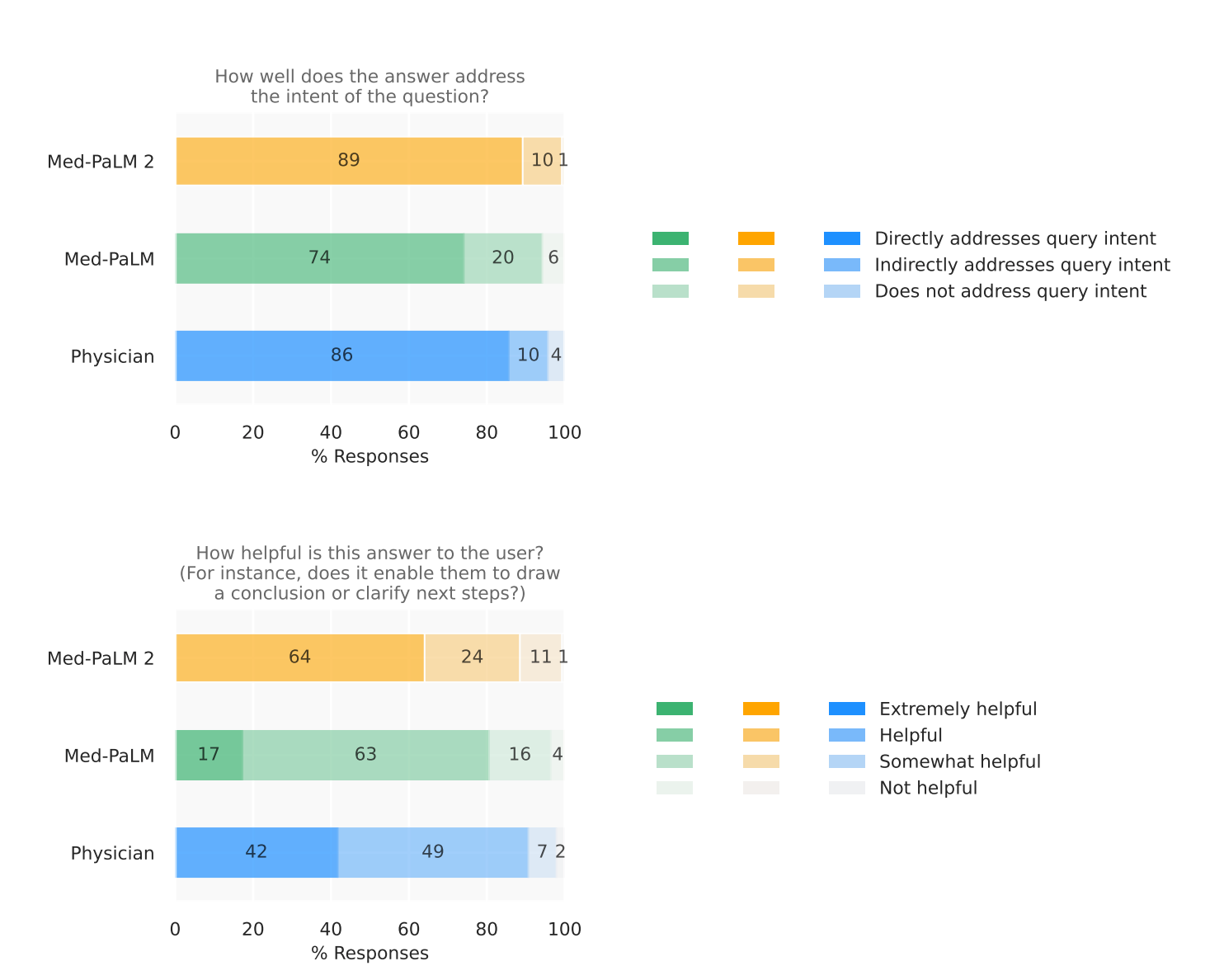
Laypeople liked the LLM's responses somewhat better than physicians' — but they also have infinite time
If you're unaware, medicine is really hurting right now: COVID and the bureaucratic American healthcare system has decimated our workforce. Doctors and nurses have quit, moved to more lucrative and less challenging and stressful work, or they've retired or died. And at the same time, the baby boomer generation is older, more medically-complex, and sicker than ever. I think these AI hold so much promise to fix so much that is wrong with healthcare today — not due to any fault of any one doctor or nurse or patient, but because of the system that expects inhuman amounts of time and focus from its dehumanized but dedicated healthcare teams.
With the right systems and safety and oversight, I'd love to see a world where I can actually focus on practicing medicine at the bedside, with a medical LLM as my co-pilot and sidekick.