MIRA and the Wrong Question
My biggest problem with this clinical AI paper is that I wish they'd kept the humans out of it.
This week brought another big agentic AI paper — MIRA (Medical Intelligence for Reasoning and Action), a German autonomous agent operating inside a sandboxed EHR. Agents, if you're new to the term, are LLMs that don't just answer questions — they take actions. In medicine: order the test, prescribe the medication, admit the patient.
MIRA did really well. And the headline you're going to see will be some version of: Autonomous AI agent outperforms doctors in the ER. Please ignore that.
The useful question this paper answers: can an AI agent convert clinical intent into structured EHR action? MIRA appears to do that well. But once you add a physician comparison arm, it stops being an engineering paper and becomes another AI-versus-doctors paper — and that framing is not just irritating, it's misleading.
The Appendectomy Tell
The physicians in this study weren't practicing emergency medicine. They were clicking through a simulated interface, selecting structured options, entering orders in a fake EHR environment. That's not an ED. It's a click-lab.
Which brings me to the appendectomy numbers.
Eric Topol, MD flagged on his Substack that MIRA dramatically outperformed physicians on appendicitis cases. My immediate reaction: there is no way in hell that humans mismanaged almost 30% of appendicitis cases, the most common "surgical emergency" that we've all seen hundreds of in our career.
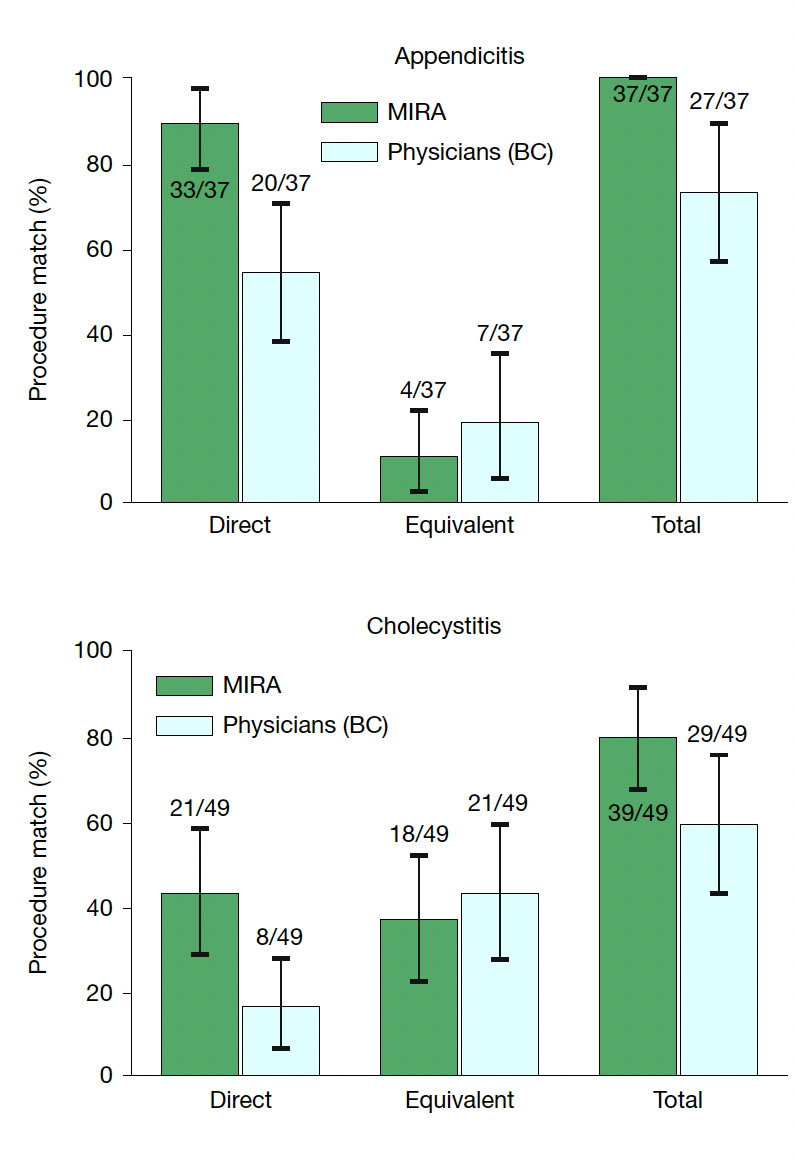
From the paper and Dr. Topol's Ground Truths substack
(NB: This is what expertise is for. It lets me look at a number and say: No way. Something's off here. In evidence circles, it's called face validity. In medicine, we call it the sniff test. Same thing.)
And once you look at what the interface actually required — 21 clicks just to order a basic CBC — the problem becomes obvious. (Germany, is this how you order labs?!) AI doesn't mind 21 clicks or 2100. AI was built for the EHR. But this MIRA benchmark expected the ED physician to explicitly search for and enter "laparoscopic appendectomy," and then counted it as a fail if they didn't. I'm not sure that's the benchmark I want applied to my medical care. I want "did the real human patient in front of me with appendicitis get seen by a surgeon?"
21 clicks for a CBC! Just imagine if you wanted a Chem7 and LFTs!
This is how AI makes doctors look bad: not by being better at the medicine, but by being better at the benchmark's representation of the medicine. And if you don't read this article, the takeaway is "Wow, doctors are incompetent, AI really is incredible."
Nobody Talks Like That
The second gap is the patients themselves.
Look at the sample dialogue from MIRA's virtual patients. They answer questions directly. They give complete, coherent histories. They volunteer the right detail at the right moment.
Real patients say "dizzy" — which can mean vertigo, presyncope, weakness, nausea, anxiety, intoxication, stroke, or I just don't feel right. Real patients forget medications, misremember timelines, contradict themselves, and sometimes save the most important detail for when the discharge paperwork is printing. Real clinical information also comes from the eyeball test: vital signs, visual appearance, the way someone's breathing, the triage nurse's something's not right instinct, family dynamics, intoxication, delirium, language barriers, social risk.
MIRA's patients aren't patients. They're clean text interfaces wearing patient costumes.
LLMs are very good at extracting structured information from cooperative text. We know this. Numerous papers have shown it. I agree with it. But that's not what emergency physicians are trained for — we're trained for the messier version. The one where the story keeps changing.
The Study I Actually Want
So what's MIRA actually good at? What's this study actually saying?
MIRA could totally support them. The real question isn't whether an agent can outperform a doctor on a simulated EHR benchmark. It's whether an agent can help a doctor do the software-shaped labor we've wrapped around emergency medicine:
- Draft medication reconciliation.
- Propose continue/hold decisions.
- Suggest admission orders.
- Check renal dosing.
- Flag missing analgesia, antiemetics, cultures, anticoagulation holds, follow-up instructions, safety-net language.
- Remember to do XYZ billing/quality/whatever metric required by your hospital/health system/state/federal regulator.
I'd love help with that — and MIRA is actually way closer to what I've been describing for a few years: the guardian angel that's looking over your shoulder, helping you not make mistakes. The perfect chief resident who's helping you manage your patient list.
That's where this paper gets interesting. Because the doctor knows appendicitis — what we don't have is infinite time, a perfect EHR, or immunity to missing one operational step while managing a department. Structured workflows break constantly. A system that makes the right action easier to execute could be genuinely valuable.
But that's pended support. Not autonomous care.
The study I actually want: doctor versus doctor-with-MIRA. Does it reduce cognitive load? Catch renal dosing errors? Improve discharge instructions? Decrease missed orders? Or does it create alert fatigue, slow clinicians down, and give staff one more machine to babysit? That's the study healthcare needs.
Conclusion
My concern isn't that this paper bruises ER doctors' egos. Physician ego has survived worse than a Nature paper. (Let’s be honest, there are probably only a handful of ER doctors in the world who will actually read this paper.)
My concern is that health system leaders will read the headline and mistake a simulated EHR victory for deployment readiness. That would mean exposing patients to a system tested in clean simulation, without the pressures, ambiguities, interruptions, and operational constraints of actual care — and asking staff to supervise, correct, override, and be accountable for automation they had no hand in designing.
MIRA tests medicine as the EHR imagines it. Emergency physicians practice medicine as reality constantly interrupts it. If we respect that gap, agentic AI could be incredibly useful. If we ignore it, we'll keep building proof that humans are bad at behaving like software.
Tomorrow: Part 2 — Google's AMIE paper on chronic condition management, and what a very different approach to agentic AI gets right and wrong.