As a baker and San Franciscan, I feel it necessary to teach you about sourdough if you want to know anything about medicine and AI, because medicine has been running a sourdough bakery continuously for the last 100 years.
Sourdough — if you somehow never had that phase during the pandemic — requires only a handful of ingredients: flour, water, salt, starter… and time. Sourdough famously requires starter — a goopy, sometimes-slimy, sometimes-alcohol-scented concoction that is wild, living, and developed through exposure and time, full of natural environmental yeasts floating around in the air. Starter cannot be manufactured, only cultivated. And when you add the starter, the flour, the water, and the salt, and let it mix together for enough time — a process called proofing — you can pop it in the oven and 90 minutes later have the best bread you’ve ever tasted in your life.
In medicine, we take students as our raw ingredients. Residents are the dough that has to proof — slowly, uncomfortably, through a fermentation process you cannot rush without ruining it. Not too hot, not too cold, but just at the right temperature for the yeast to double and grow. And out pops the sourdough loaf, the attending physician. The starter? Clinical judgment: ways of thinking, evidence, experience... passed down from generation to generation. The practice of medicine, then, is baking the sourdough, and teaching the next generation how to bake it too. Through watching, attempting, failing, and being corrected. You can’t make bread by reading about it. You have to actually do it. (My Nana, who made the best dinner rolls from scratch and from whom I inherited my baking chops, famously could not tell me her recipe. There was not one to write down. "You just add the flour until it feels right and looks like that," she once explained.)
AI is the first technology that threatens to break this process, by offering a faster, cleaner, more convenient alternative. Perhaps even a better one, as well. (I mean, who doesn’t love Wonder Bread?)
But to understand why AI might be delicious but not as satisfyingly complex and nutritious as sourdough, I need you to sit with another question:
Do you want AI to be like the EHR, the hospital lab, or the attending herself?
Your answer determines whether we're building a better healthcare system, or quietly losing the starter. Here’s what I mean.
The EHR is infrastructure. Important infrastructure — perhaps even critical — but infrastructure all the same. If the EHR goes down, that will suck, and care gets WAY slower, clunkier, and probably somewhat lower quality. But I can still practice medicine, more or less. I can make diagnoses, I can get a lot of stuff done, I can handle most patients most of the time. The EHR collects and organizes data for the humans. But I can still say "Yeah, you've got appendicitis, I've called the surgeon!" without much fuss.
The hospital lab — or even the CT scanner — are services I can’t practice without. (Calling them “ancillary services" is the grossest understatement of the century.)
Fact: I cannot examine you and figure out your sodium.
Fact: I cannot touch your skull and deduce if your stroke is from ischemia, bleeding, or a tumor.
Fact: if you come into the ER confused, I lack the ability to tell you what your kidney function is.
Dependence on these tools isn't a failure of my education, training, or clinical judgment. It's the structure that modern medicine fundamentally requires. I become a shell of an ER doctor without a working lab or a working CT scanner. Labs and imaging don’t organize data; they enhance and extend my perception. They give me new abilities. Literally x-ray vision. These services make me capable of making decisions and providing answers that I do not have the ability to offer without them.
Finally, do you think AI is like… me? "The attending." I offer something else entirely. I synthesize, prioritize, and judge — but more than that, I am also how medicine learns to do those things in the next generation. When a resident watches me work through a sick patient, or commits to a diagnosis, gets it wrong, and gets corrected — that loop is not a side effect of training. That loop is the training. I am both the baker who knows when the dough is ready, and I preserve part of myself as starter — the living culture passed forward to seed the next batch of doctors — along with everything I know about the flour to water ratio, the timing, the oven temperature, and the feel of the dough when it's right.
(I'm also licensed by my state, boarded by my specialty, and medico-legally responsible for my patients to make good decisions with them or on their behalf. But that's a different essay.)
I would argue that AI is starting to run the bakery, or at least its overlords would like it to.
So what is AI to you, or what do you expect it to be? The consequences are very different.
Nature Med's AI-induced never-skilling
A new article from from Ke Yuhe Liyuan Jin Nan Liu, PhD, FAMIA et al. argues we're not asking this question carefully enough. And I think they're right. They draw a distinction that doesn't get nearly enough attention: the difference between de-skilling and never-skilling. You've maybe heard of de-skilling; what happens to experienced clinicians who stop practicing a skill: it erodes with time, just like speaking a foreign language. Never-skilling is something more alarming: a trainee who never develops the capacity to reason independently in the first place. Not forgetting how to think, but never learning how.
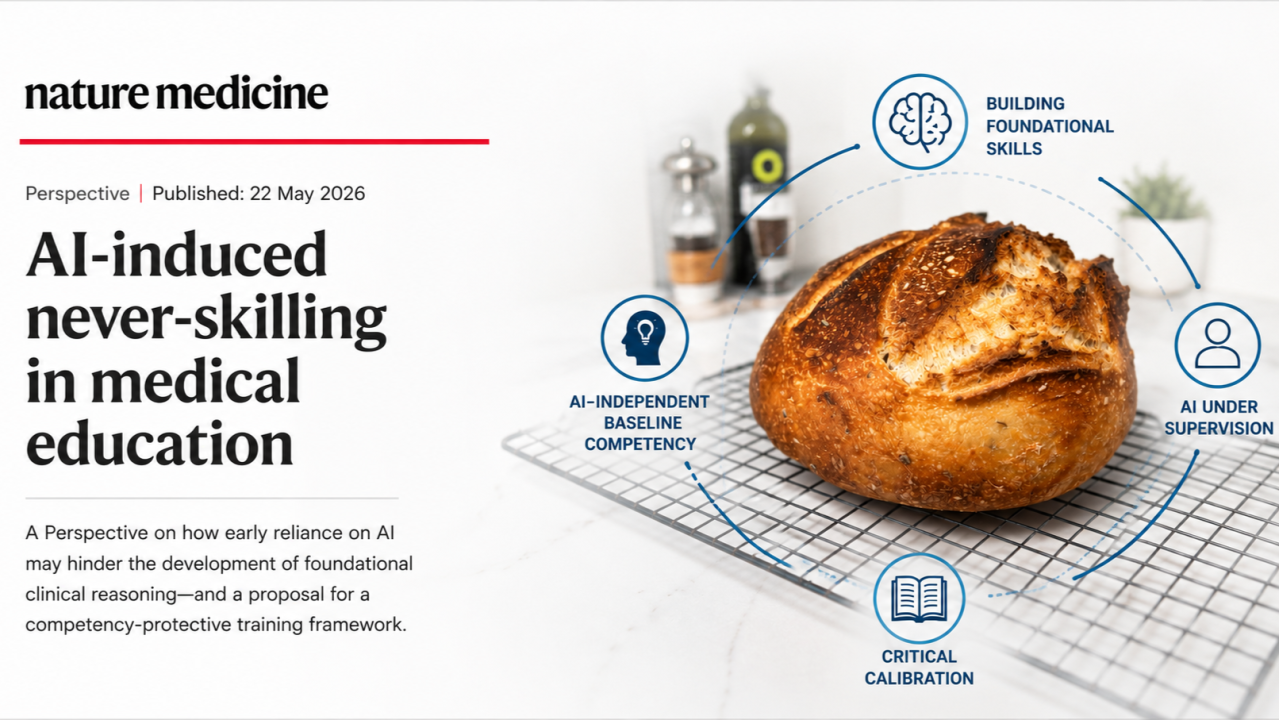
Nature Medicine, May 22 2026
They identify three ways the proofing phase gets skipped:
- First, competency acquisition crisis. Clinical reasoning develops through what the paper calls "productive struggle" — the cognitively demanding, sometimes uncomfortable process of sitting with uncertainty, generating hypotheses, being wrong, and revising. That struggle isn't inefficiency. It's the mechanism. When AI generates the differential before the trainee has attempted one, it bypasses the very process that builds the underlying cognitive architecture. The paper's image is stark: a student who can identify diabetic ketoacidosis with AI assistance but "fails to recognize it independently when it presents atypically" — for example I’ve occasionally seen it in patients whose only complaint is abdominal pain. The resident may look or sound confident until you remove their support. Pull the bread and it collapses, often because you didn’t develop the gluten long enough.
- Next, the calibration paradox. If you've never developed independent reasoning, you also can't evaluate whether the AI is wrong. You lack the internal model to question the output. The paper calls this "cognitive moral hazard" — trainees don't just defer to AI, they abdicate responsibility entirely, because they don't have the knowledge base to know when to push back. (And LLMs, as we know, are extraordinarily confident.) They don't say I’m not sure. They produce fluent, assured, occasionally wrong answers. A trainee without calibrated independent judgment has no reliable way to tell the difference. They can't look or feel the dough like my Nana and realize, “I messed something up, something's off…” because they've never baked.
- The last one is the metacognitive and professional identity deficit. It’s a mouthful but the most worrisome; essentially the authors suggest that if you’re persistently miscalibrated, that actually reshapes your identity. You don’t think of yourself as an attending who’s both responsible and knows how to do the right thing and how to approach problems, but you perhaps see yourself as a simple technician. That your identify becomes only implementing machine-generated outputs. The computer says to insert the needle here, so I guess I should insert the needle here. (Anyone who's seen drivers in accidents because they were "just following the GPS" should be similarly concerned.) If that identity forms — and I would argue that the lack of autonomy in medicine has already made many attendings sometimes feel that way — it’s not just a training problem. It's a starter problem — the culture you were supposed to pass forward has been replaced by something that can't seed the next batch.
But it’s not just problems here; the authors propose some great solutions for us as well:
- Phase 1 - AI-free zones. Establish baseline competency first, no AI allowed. Mandatory AI-free assessment periods in medical school and early residency. The analogy? Pilots must maintain manual flight proficiency even when autopilot is available. You have to be able to fly the plane before you hand it to the computer.
- Phase 2 - Adversarial Pedagogy. Once their baseline is verified, introduce AI through deliberate red-teaming. Present trainees with intentionally flawed AI outputs — an anchoring bias that causes a missed PE, an overconfident assertion of viral meningitis — and grade them on their ability to identify, articulate, and correct the errors. Build the skepticism in from the start, and show them that these are increasingly important and teachable skills.
- Phase 3 - Supervised integration. Full AI collaboration in residency, tied to professional activities with progressive autonomy — but only after Phases 1 and 2 have done their work. (Now you can use the stand mixer instead of the wooden spoon, because you’ve earned it.)
The question I have is whether medical education moves fast enough to implement it before we've lost a generation to the shortcut. I love ya, medical educators, but neither speed nor “let’s try things differently” are your strong suits. Some of you are more likely to implement a “Likelihood of AI Concern” scale and publish it as a survey instrument than you are to actually admit “this is a problem we needed to address yesterday.”
Back to the question: what do you expect AI to be in medicine?
If AI is the EHR, then downtime is an inconvenience, not a catastrophe. Medicine slows down but doesn't stop. And if trainees learn medicine with AI as infrastructure, they can still function when it's gone. None of the three failure modes get triggered in any serious way — because the AI was never doing the cognitive work to begin with. The bakery keeps running. That's manageable.
If AI’s the lab, we have a much bigger problem. If AI becomes as load-bearing as the CT scanner — if clinical decisions genuinely cannot be made without it — then a system outage isn't an inconvenience. It's a patient safety event. The calibration paradox kicks in at scale: an entire clinical workforce that has outsourced perception to a system it can no longer independently verify. (Just like how I have outsourced the fact that I cannot deduce your sodium level by talking to you or examining you.) And we'd better be very sure we're okay with that dependency before we build medicine around it the way we built it around the lab.
But if AI is the replacement attending? All three failure modes activate. The competency acquisition crisis hits first — productive struggle disappears, hollowed scaffolding forms. The calibration paradox follows — trainees can't question what they've never learned to do themselves. And the professional identity deficit completes the picture: a generation of physicians who are, in the paper's framing, operators of machinery, not doctors seeing patients; they are people relaying outputs rather than exercising judgment. The dough never proofed. What came out of the oven looks like bread. But it sure isn’t sourdough. And you can't use it to seed the next starter.
Conclusion
This is the problem that I do not understand how to solve, and I ask every smart person I know about, hoping they have an answer. This paper from Ke is the best framework and proposed solution I’ve seen yet.
The medical students and residents training today are the attendings of 3-8 years from now. That means they are the doctors who will be operating on you, helping you, treating you, and diagnosing you very, very soon. If we let AI act as the attending before they've learned to think for themselves, we won't know what we've lost until it matters most.
Do we want better, more convenient, on-demand care right now? Is it worth risking losing medicine's ability to reproduce itself forever?
We've baked a lot of good sourdough bread.
Maxim (Max) Topaz PhD, RN, MA, FAAN, FIAHSI, FACMI — who's been writing about skilling this week; Amy Zolotow who brought me some sourdough starter at HIMSS when mine accidentally got discarded; here's the easiest no-knead sourdough bread recipe for beginners I've found and these sourdough starter crackers are, literally, like crack.