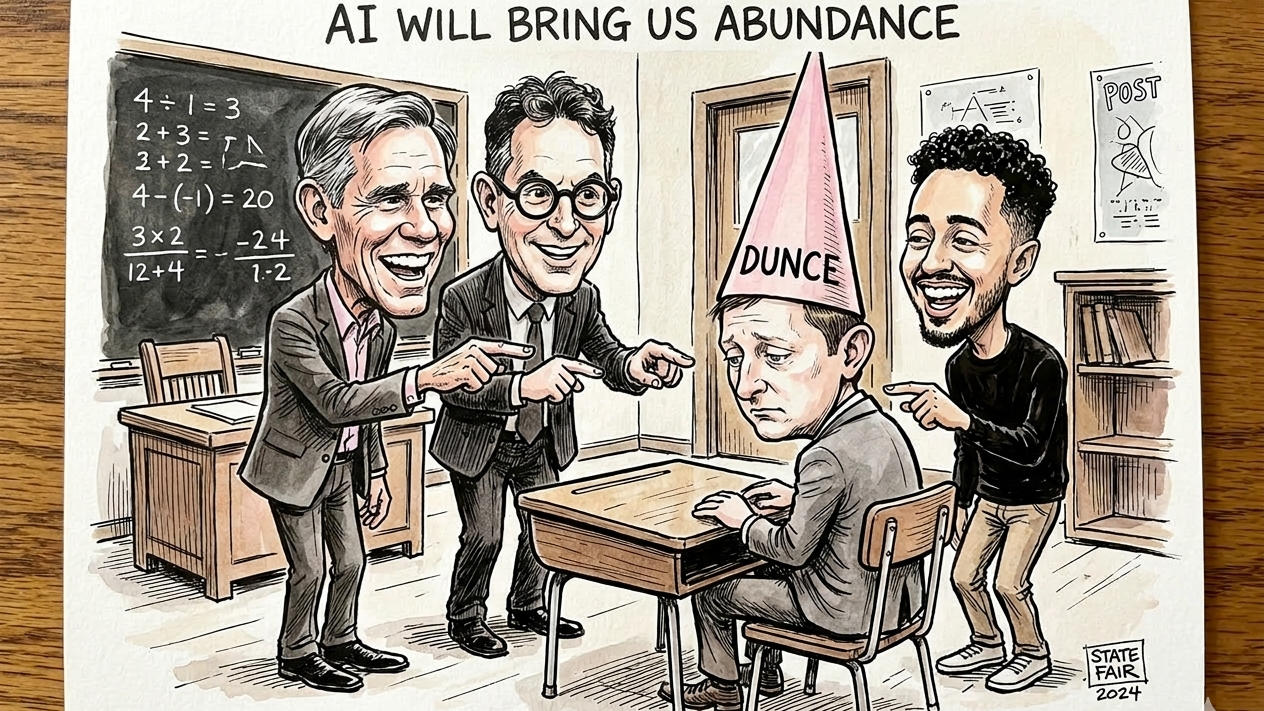
Eric Topol's Super Agers was not the first time I'd heard an argument for more testing in medicine. Versions of that idea are all over the internet, usually attached to someone trying to sell you a full-body MRI, a boutique blood panel, or a biologically impossible explanation for your fatigue. But when Eric Topol, MD made the case in his book, I actually stopped to consider it for a few seconds.
The next time I heard it was over Vegas buffet wagyu sliders last week, when I ran into another giant in the field at HIMSS: John Halamka, M.D., M.S. We started talking about AI and technology, and meandered toward an even more esoteric topic: echocardiogram wait times. Dr. Halamka made a similar point; AI may soon make it possible for almost anyone holding an ultrasound probe to acquire really good echo images, dramatically expanding access to testing. In that future, we will probably do many more echos, while human echo technicians would increasingly be reserved for the hardest cases.
At that point, hearing two respected leaders in medicine argue some version of "more testing," the question in my head changed. It was no longer, "Is this fringe hype?" It was, "What exactly am I missing here?" Because I've had something drilled into my head since first year of med school: wanton ordering of tests mostly creates false positive noise.
These are smart, serious physicians who understand Bayes' rule of probability. They know about false positives, pretest probability, referral cascades, and cost. They are not imagining a cartoon future where every patient gets every test every week. Their argument, as I understand it, is that AI is about to break the supply bottleneck: lower the skill threshold to acquire an image, standardize interpretation, reduce labor constraints, and dramatically expand diagnostic capacity. Morgan Cheatham, MD at Breyer Capital has been making a related case, writing that "the greatest impact of AI in medicine will be measurement" — more observable biology and more computable signal from audio, video, wearables, molecular data, and latent patterns in clinical records.
I find this future compelling, often daydreaming about the promised abundance. And it's entirely possible that there is just so. much. data in the future that much of this just kind of... falls into place. This essay is an attempt to take the abundance argument seriously — and to understand why it still feels incomplete to me. I don't think the access advocates are wrong; they are right about the problem and right about a big piece of the solution. But I'd like to argue that supply-side expansion alone is not sufficient. It needs a companion piece, and without it, testing abundance for the well will erode the system for the sick.
Why the abundance case is so appealing
There's a patient I'll call Jarell who illustrates why more access to testing is attractive. At a routine checkup, Jarell's PCP hears a new murmur and orders an echocardiogram. In a well-resourced system, he'd get one that week. But in today's world, the earliest outpatient echo is six weeks away. Jarell works two jobs, misses the appointment, and the rescheduled visit is booked a month later. By the time he gets the echo, he has moderate valvular disease that had probably been progressing for a while. Nothing catastrophic — but time he didn't need to lose, and a gap in care that had nothing to do with clinical judgment and everything to do with capacity and scheduling.
That is the world the abundance advocates are reacting to, and boy could I tell you stories about it from the ER. Patients with real disease wait too long (especially in a society that offers no mandatory sick leave), not because their doctor made a measured decision to watch and wait, but because the system is just... full. Some of those patients' symptoms resolve during that waiting period (waiting is not exclusively negative), but others progress and often end up in the ER under my care. If AI can break that bottleneck — lower the skill threshold, standardize acquisition, expand who can do the test and where — then for patients like Jarell, more access is a moral imperative.
But easier access in healthcare never just improves throughput. It always changes test ordering behavior at the same time.
Two futures hiding inside "more access"
Healthcare has plenty of adages for this pattern: supply creates demand; if you build it, they will come. Academics might cite Jevons paradox. Lower friction changes thresholds, ordering patterns, patient expectations, and who enters the diagnostic pathway.
What should happen is future A, where we are testing the same kinds of patients, just earlier and more efficiently. Jarell's getting his appointment sooner. More real disease is found earlier because we have more capacity to perform the tests that find it. Clear win.
What actually happens when testing access improves? We get the test "just in case" or "because we can" that we otherwise wouldn't get. The test gets used in broader, lower-risk populations without murmurs. This expands the denominator. And now a positive result actually means something different than it did in future A. Because your population is already low risk, you have to be way more skeptical about positive results in the first place. Positive tests in this scenario creates a much larger stream of ambiguities, referrals, surveillance decisions, and downstream costs, and mostly in patients who don't have anything wrong with them.
(I should also clarify the above — this is not just "lazy doctors" or "testing ordered for convenience." Truly, if we want to find more disease in the world and "catch stuff early" and "be preventative" and go from making 99% of diagnoses to 99.1%, we have to do way more testing. There's no easy way around that.)
"AI makes testing so accurate that false positives won't matter"
This is the most intuitive version of abundance optimism: AI interpretation will be so good, and specificity so high, that expanded volume won't generate much noise. Better technology, fewer wrong answers, problem solved.
But for this to be true, AI has to make tests not maybe twice as good, but arguably 20 or 100 times better. Using the echo analogy, in a low-risk direct-to-consumer population with no murmurs and maybe 0.1% prevalence (999 out of 1,000 people do not have any heart problems), doing echocardiograms on all of them — the gold standard test for structural problems with your heart — means that you need to make room for about 101 additional cardiology appointments, while only 1 of those 101 truly has structural heart disease. 99% are false positives.
Health systems do not drown in average test performance. They drown in the absolute number of wrong escalations. If downstream capacity is fixed, even a modest false-positive rate becomes operationally overwhelming as test volume expands.
"AI will expand capacity at every level, not just the test"
This is the more sophisticated version: why assume the downstream stays fixed? If AI breaks the echo bottleneck, won't it also break the cardiology bottleneck? AI-assisted triage, AI-augmented follow-up, AI reading the repeat imaging. The whole pipe expands. "You've got to think bigger, Graham!"
It's a fair challenge, and partly right. AI can and will augment some downstream layers. But a test is not an endpoint. Surprise! It's just the front door to the next healthcare line. A positive echo creates a cardiology visit, maybe repeat imaging, maybe surveillance, maybe a valve clinic, maybe procedural evaluation, definitely more documentation, and certainly more patient expectation. Ultimately someone or some algorithm has to decide if or when to do the next thing: start a medicine, get a procedure, order another test... or decide to stop doing those things.
Some of that chain is compressible by AI, but I would argue the most important parts of it are not. Shared decision-making about whether to pursue surgery. Building trust with a patient who just learned they have a heart problem (or is confused and frustrated when the specialist says they don't actually have one). Procedural evaluation that requires hands on a body.
The bottleneck does not disappear. It migrates to whichever layer AI cannot fully automate — and then that layer gets more overwhelmed, not less, because everything upstream is now running faster.
Without a way to distinguish between "we found real disease" and "we're sure this is a false positive," the patient wait just moves from "6 weeks for an echo" to "9 months for a cardiologist."
"AI makes testing so cheap we should just do more of it"
There's also an economic angle that seems insurmountable to me, non-economist: If "AI" increases access, then the unit cost of the test has to plummet, or we'll end up spending our entire healthcare budget on AI echocardiograms.
The payer math is brutal, and I am not usually one leaping to defend the payers: total spend equals number of tests times cost per test, plus downstream costs. If orders for testing rises dramatically, one of three things has to happen: volume remains tightly controlled despite easier access through more waiting; price per test falls substantially; or total spend rises substantially. (Payers are not famous for accepting option number 3.)
And even that equation is incomplete, because the technology is not free. AI doesn't eliminate cost. It changes who gets paid. The old model was expensive expert labor and constrained throughput. The new model may reduce some of that, but now you add in hardware, ultrasound probes for every exam room, software licenses, compute, integration, monitoring, QA, governance, support, and, in many cases, a venture-backed company that would also like a healthy margin. How does that all factor in to commodity-ish pricing?
Whether AI can do the test is not the hard question. Can the AI stack deliver testing at low enough cost and high enough quality that the system still comes out ahead after the vendor, the hardware, and the downstream utilization all take their slice? That's the real one.
The missing companion piece
So those are my concerns with "echos for everybody" argument. The case for expanding supply is real, and the harms of scarcity are real. But what I think is missing to the story is a demand-side solution, too.
The answer is not "human judgment alone" and it is not "test everyone because AI made it easy." I think the most promising path is AI-assistance to shape the demand for testing plus selectively AI-expanded supply.
"AI-assisted demand shaping" sounds like economist techno-wordsmithing, but I really just mean "technology that helps doctors make better decisions." What if AI's first job was improving the decision to order the echo at all? That means helping clinicians widen the differential (or narrow it), avoid premature closure, surface uncommon but dangerous alternative diagnoses, estimate risk more consistently, and recognize when a patient's signs and symptoms might not fit the standard mold. Once the patient crosses a better-informed threshold, AI can help with the downstream work: acquisition, interpretation, routing, and follow-up.
This is where tools like polygenic risk scores, multimodal biomarkers, wearables, longitudinal clinical data, and latent signal in the record become essential — and I should certainly acknowledge that I think this is part of Eric Topol's equation as well. The idea here is that we aren't using AI to replace clinical reasoning, but to allow us to raise our pre-test probability, so that the patients with positive tests are more likely to be true positives than false ones.
Think about what this actually changes. In the current system, "you don't qualify for screening" is usually an age cutoff or a checkbox risk score — blunt instruments that miss plenty of real disease while also generating false reassurance. In a world with better demand-side tools, the alternative becomes something more individualized: your longitudinal data, family history, biomarkers, and risk model don't currently suggest enough risk to justify the next test. Or the opposite: We wouldn't normally consider this diagnosis in your (age range, symptoms, etc) but your risk appears to be much higher than we'd expect it to be, so let's get that test scheduled for you promptly. That is a more honest and way more individualized answer than an arbitrary threshold like age, and it's a more actionable one — because it can change dynamically as your data changes, too.
In that framework, "more testing" is really shorthand for risk-enriched testing: earlier detection, more personalized priors, smarter allocation of scarce downstream resources. For example Topol has made exactly this point in the multi-cancer GRAIL early detection debate: broad age-based screening constrained pretest probability too low, while risk-based enrollment would likely perform much better.
A smarter front door, not just a wider one.
This maps to how experienced physicians already think. Most well-trained doctors don't need decision support for the majority of patients we see. AI's value lives at the edges of the map: the atypical presentation, the rare disease, the contradictory signal, the moment when the case doesn't quite fit and certainty starts to fray. Good clinical AI should probably be quiet most of the time and loud when things get strange — which is precisely when the decision to order the next test matters most.
The real design question is not whether AI can break the first bottleneck. I have no doubt that it can. The question is whether we build AI that supports reasoning and restraint, or just AI that makes it easier to escalate.
More access without better judgment gives us more testing and more noise. Better judgment without more access gives us islands of excellence trapped behind old constraints. Both together might actually get us something better.
The future of medicine is not more testing. It's better judgment at scale.