When you enter Edinburgh's Surgeons' Hall Museum, you're encouraged to climb the narrow steps of a small surgical anatomy theatre, and take a seat to look down upon a pale, wooden figure in the general shape of a human below you. An actor in old-timey surgical garb reminds you that you’ve travelled from afar to learn from the faculty of the Royal College of Surgeons, the master anatomists of the time, who will teach you what they’ve learned about the body. Moments later, a video projection shines down upon the figure, illuminating it with the layers of the body, while various lecturers describe the skeleton, or the thorax, or the function of the pancreas and the mesentery.
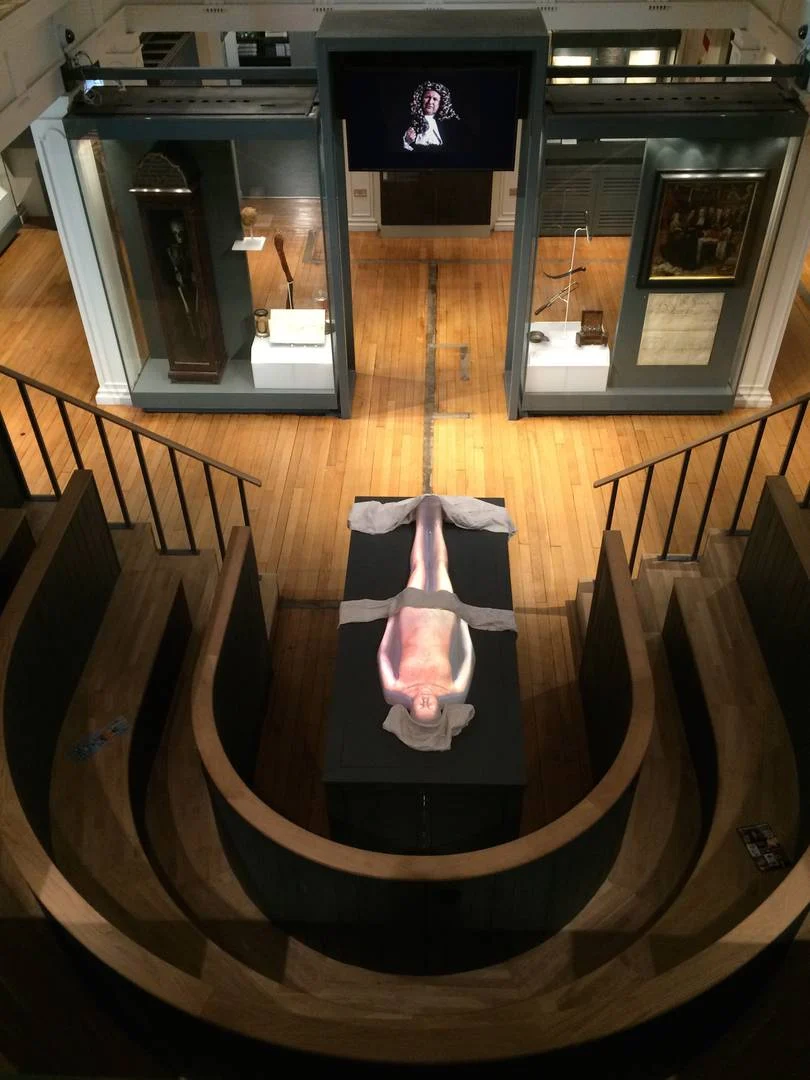
The aforementioned Anatomy Theatre from the museum
And while I was mostly sitting there to rest my feet, I decided to play along. What if I was learning this stuff for the first time, word of mouth, hearing it from a famous surgeon that I’d travelled 1,000 miles to see? How much of what he said was right, and how much was spectacularly wrong? Or would I even dare question him and his experience?
As the 10-minute video started over on its loop, I stood up and started mulling around the exhibits behind glass: ancient needles, tools invented hundreds of years ago to cut into the skull without damaging the brain, medications that did and did not work to help other humans. But I couldn't get the thought out of my head: what were these surgeons actually trying to do?
While I can easily look down at them from my high horse — carrying the world's information accessible from a small screen in my pocket — I also have the luxury of all the doctors who came before me. I’ve learned from their billions of errors, assumptions, and mistakes. If I turned off my retrospectoscope, how much better would I have been at finding patterns and correlations, let alone correct causation, without a stethoscope or medical textbook, let alone computers, lab tests and CT scanners?
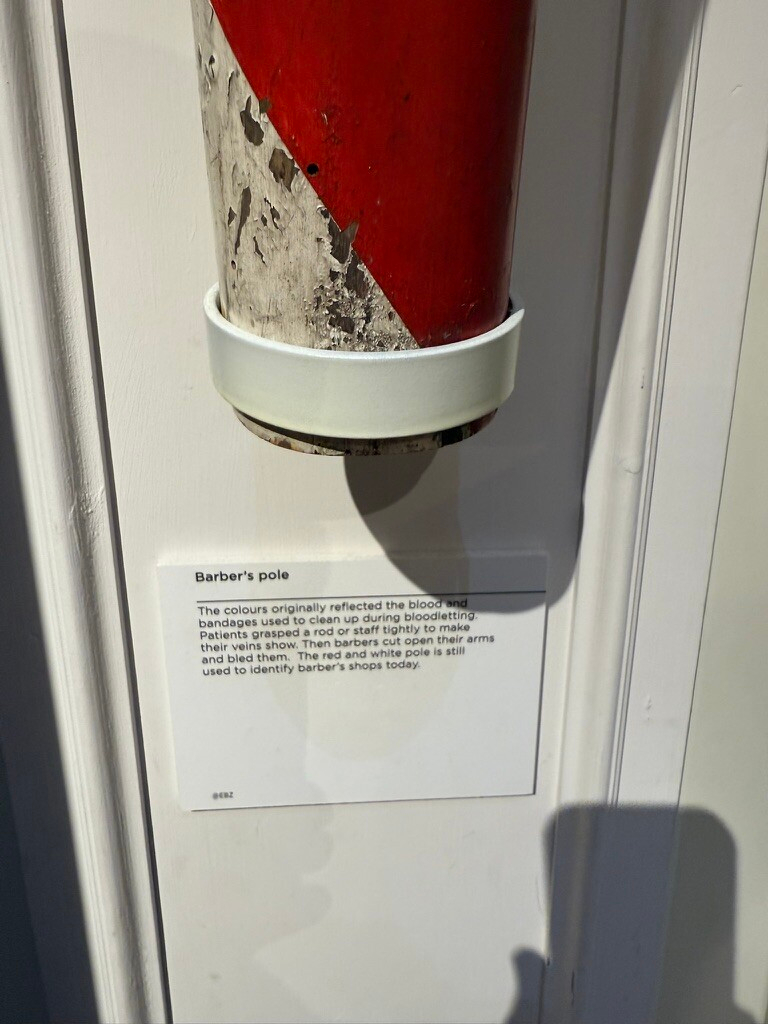
Had no idea the Barber's pole represented blood and bandages
A swirl of thoughts raced through my head as I continued through the museum, seeing the advancements that took centuries to adopt and then spread: Microscopes. Vaccines. Koch’s postulates. Harnessing radiation. Discovering antibiotics. Toward the end of the small museum tour, you enter a bright, spacious specimen library with thousands of preserved body parts on display, broken up by system. You see the remains of other human beings who suffered — and died with or because of — diseases that existed, couldn't be addressed, or couldn't be understood by local doctors. Pott's Disease. Congenital malformations. Aneurysms. Broken femurs that didn't heal.

The specimen library
Three questions kept surfacing in my head. And I don’t have the answers for two of them.
1. Isn't AI just supercharged pattern recognition?
Doctors have always been pattern hunters. "Hey, people who get water from this well in particular keep getting cholera." Or "Milk maids seem to never get smallpox." These observations — right or wrong — drove medical progress for centuries. And many, in fact, were entirely wrong, despite making perfectly good sense on the surface. “Eat less fat to lose weight.” Or, “If we block an artery to divert more blood to the heart, it’ll improve blood flow.”
Today, AI is doing the same thing, just exponentially faster and with vastly more data. Where John Snow mapped cholera cases by hand to identify the Broad Street pump, machine learning algorithms can now identify subtle imaging patterns that may predict Alzheimer's or Parkinson’s years before symptoms appear. Where physicians once noticed that certain heart rhythms preceded sudden death, AI can spot heart attacks we’ve been missing since the electrocardiogram was invented a century ago.
The fundamental process hasn't changed: we're still hunting patterns, testing hypotheses, and trying to reduce suffering. I truly believe that you cannot see patients and not see patterns emerge. I’m not a “researcher” in the formal sense of the word, but over my career I’ve found little tricks and subtleties in the ER that help me get to the right diagnosis faster. With AI, we’ve just upgraded our tools from formaldehyde specimens and crude microscopes to neural networks processing petabytes of genomic data.
I don’t see AI as any different from the data collection and analysis for the Wells’ Criteria or the even more-advanced PREVENT Equations, just more data and more compute.
But these next two questions continue to linger, because I’m not sure they can be answered.
2. What would those Edinburgh surgeons think of our AI paralysis?
Here's where it gets uncomfortable. Walking around all those specimens — dead children, amputated limbs, incurable cancers and infections — I felt so privileged to have so much technology available to me today. Those surgeons would kill for even 1% of the diagnostic power that I can access with the click of a mouse. Yet we're sitting on AI systems that could outperform radiologists at detecting certain cancers, predict sepsis hours earlier than current protocols, and identify drug interactions we miss — and we're barely using them.
Why? Because we're terrified. Terrified of malpractice suits. Terrified of regulatory backlash. Terrified of being wrong in a new way instead of wrong in the traditional way.
Meanwhile, patients wait, or fall through the cracks, or get angry with us and lose trust that we actually want to help them. Diagnostic errors occur (though not as often as they’re suggested). Errors of omission and commission inter-mingle. We delay cancer diagnoses at rates that would horrify those Edinburgh surgeons. “You can detect cancer before it’s spread everywhere, and you’re just… not?” I imagine them asking me. They worked with primitive tools but embraced every advancement they could get their hands on. Death was so common for them that I’m not sure they’d understand our world with relatively less of it.
We have revolutionary tools and are paralyzed by the possibility of imperfection. (Leave it to Type A doctors to be responsible for that one.)
3. But what about all the times medicine got it catastrophically wrong?
Just as I was ready to conclude "Yes, how foolish we are for ignoring AI's power," I realized what the museum had left out: all the times medicine — and individual doctors — were not just wrong but actively harmful.
While some specimens on display died of their diseases, how many died from bloodletting? Or surgical techniques lacking sterility? How many people survived despite their doctor or surgeon? How many suffered from mercury douches, trepanation, or lobotomies performed by well-meaning physicians who truly thought they were doing right?
Museums can display the errors and mistakes, and many do today. They can highlight the imperfections, no matter how uncomfortable. But human history — especially medical history — is littered with confident assertions that proved disastrously wrong. And all those sharp, stabby bits of miscalculations and misjudgements get smoothed over when looking backwards.
I have no idea how many of Louis Pasteur's ideas were totally wrong, or how often Marie Curie's theories led nowhere. Perhaps Joseph Lister had brilliant insights about antisepsis but idiotic theories about everything else. Or how many people were injured or harmed by the experiments they did?
The Messy Reality of Progress
The ultimate challenge along the path of progress is deciding what to accept and what to question. If wax injection of the hand to show blood vessels was cutting-edge technology for those ancient surgeons — yet we've built our medical knowledge on top of theirs — how do we know what's fundamentally correct about their conclusions and what needs to be thrown out?
This whole time — even today — we're trying to take something as incomprehensibly complex as human biology and distill the interactions of atoms and molecules and cells and organs into something the human brain can actually fathom and then act on.
Here’s the only way I’ve been able to resolve questions 2 and 3: We need to be humble because doctors in a hundred years will look back at what we thought and consider it laughably primitive. But we also need to be bold enough to use the tools we have — imperfect as they are — to reduce suffering right now.
The Edinburgh surgeons didn't have the luxury of perfect knowledge, so they used what they had. (From my vantage point… it wasn’t… great.) We don't have perfect AI, but we have systems that are often better than our current standard of care. The question isn't whether AI will make mistakes — it's whether those mistakes will be fewer and less harmful than the ones we're already making. We don’t get to consider risk in isolation or in vacuum — we have to consider the over-under on it all today, in the messy, discombobulated version of life and Earth that we’re all wading through together.
Humans are constantly synthesizing information, processing it, and simplifying it. We've been doing it for millennia. And while we think we're at the cutting edge today, we're really just in the middle of an ever-evolving process of knowledge and discovery.
Sitting in that Edinburgh museum, surrounded by the preserved remnants of diseases we've conquered and tools we've discarded, I was reminded that medical progress isn't a smooth upward trajectory. It's a messy, error-filled climb toward better understanding.
The surgeons who filled those original anatomy theatres — sponges for any and all knowledge they could bring back home with them — would probably think we're crazy for having these powerful tools and being too scared to use them. And yet the doctors of 2250 will probably think we were insane for reasons we can't even imagine today.
But that's the price of being human. We're always caught between the hubris of thinking we know everything and the humility of realizing how much we don't. The trick is finding the courage to act anyway, in the name of making the tiniest dent in the bucket of suffering while we're on this massive rock, hurling through space and the void.