With fond memory I still recall the ability to squeeze my Honda Fit into the tiniest of San Francisco parking spaces, becoming one with my car for a moment. I could use my mirrors and automotive proprioception to judge distances down to the centimeter. I’d thought that the skill was a permanent addition to my others: smelling ketones on a patient, being able to harmonize any song, or a photographic sense of direction once oriented in a new town.
But that skill is, at best, now rusty, thanks to my Kia’s backup camera and proximity sensor. The thing that worries me is that I didn’t even realize it had atrophied and oxidized until I got into my rental car here in the Azores.
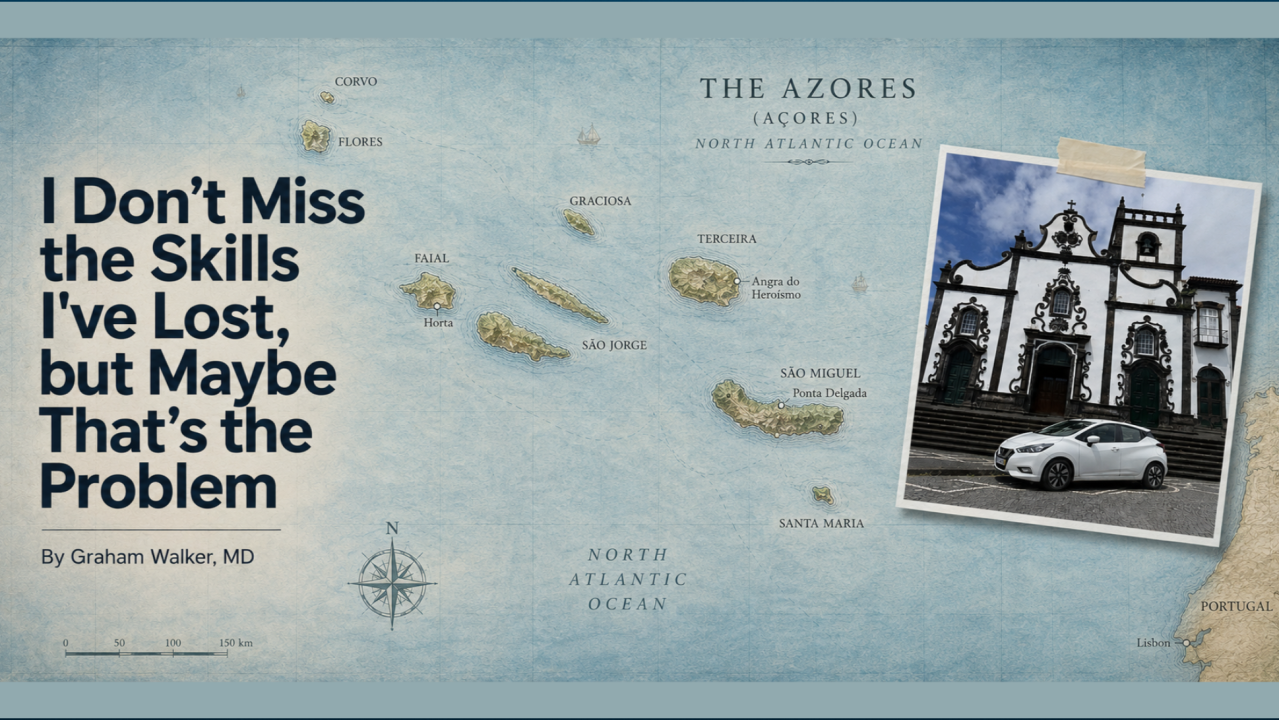
The 2018 Nissan Micra has most of the things you need for this beautiful “Hawaii of the Atlantic” archipelago: a working motor, a stick shift for the numerous inclines and hills, and 70,000 kilometers on the odometer. What it lacks in backup camera or proximity sensors it makes up for in European hatchbackness, able to fit our luggage perfectly.
But despite having driven since age 14 (yes, that’s legal in Kansas), I did not expect going in reverse to have become this hard. Every reverse, every tight spot had me asking “How big is this tiny car?” I wasn’t checking mirrors twice, but four times, almost not remembering which one to look at for parts of the process. Easing onto the clutch, while strangers probably watched me hesitate with 10 feet of clearance between me and the car behind.
I still catch myself staring, first, at the infotainment system, expecting to see a camera, and then finding none. Even still, I continue to stare as I reverse, expecting to eventually hear a proximity sensor beeping back at me. Zero for 2. Only then do I remember to crank my neck and turn around to look behind me. Three years of a sensor doing that check for me, and looking-first had quietly stopped being my default. Not because I lost the ability. Because I stopped practicing it. This was not mentioned in the Kia owner’s manual.
And let’s just call a spade a spade here: “rusty" is doing a lot of work in my description. Rusty means worse. I don't get to redefine the word just because I don't like what it implies about me.
The clutch is always clutch
But I’ve noticed another skill while driving here on São Miguel which came back immediately: the stick shift. I haven’t driven a manual transmission regularly since my high school 1996 Mazda Protege, but why was this skill burned into my brain, like I’d expected my car-in-reversing to be?
So I did some reading — yes, this is how I relax on vacation — and realized that they’re completely different skill classes. A stick shift is muscle memory: clutch, timing, hear the engine, feel the car. Left foot, right hand, left foot, right foot coordination. But reversing into a spot is a judgment skill: spatial estimation, risk-checking, visual confirmation, deciding how much clearance is enough. One lives in the hands and cerebellum. The other lives in attention and cerebral cortex. Attention and judgment are the skills that erode.
This is not just my theory. It's the finding from decades of studying autopilot-dependent airline pilots: when automation flies almost the entire trip, what degrades isn't stick-and-rudder handling. That tends to hold up fine in experienced pilots. But what those pilots lose is, frighteningly… judgment. It’s recognizing something's wrong, deciding how to respond, and integrating information under pressure. The physical skill survives. The cognitive one goes first, and it goes further and faster.
I’m not anti-backup-camera
I love the backup camera. It automated away a task humans are genuinely imperfect at (physics is physics, and blind spots are gonna blind-spot). Backup cameras and proximity sensors get us closer to perfect. Yes, this is a trade — but for parking a car? A fair one. I don't really need that skill, and I see a real gain from the trade.
Medicine has already repeatedly made this exact trade, and in the past, I think it was a fair one. Take the complete blood count, the most commonly ordered blood test in all of medicine. Doctors used to actually count the blood, hence the name: you spin down the blood, you put a drop under the microscope, and you count the red cells, the white cells, and the platelets, and voila, there’s your results. But the automated CBC machine deskilled those doctors. Most of us today could not sit down and hand-count a peripheral smear the way a tech or a hematologist could in 1985, and that's completely fine. We swapped a craft skill for a faster, more consistent tool. Nobody's mourning it. No one’s reminiscing for the days of yore when you spent your time counting cells.
So here's the question that's been sitting with me since São Miguel: what happens when the skill on the table isn't "how big is my car," or counting neutrophils by eye — but clinical judgment itself? The differential. The reasoning. The decision to act, or wait, or refer. Do we want doctors closer to perfect if the price is that doctors, as a whole, get worse at thinking? The aviation data makes me nervous, because judgment is exactly the skill that erodes first — and the one you notice missing last, right when you need it most.
Now — backing up a Micra is an embarrassingly simple judgment task by comparison. Distance, angle, closing speed. A handful of variables, bounded by physics, with a ground truth you can point a camera at. Medicine doesn't have that ceiling. A patient isn't one variable with a right answer underneath it — it's dozens, half of them missing or contradicting each other, layered with history, comorbidity, and an evidence base that's often genuinely unsettled. Thousands of shades of gray where reversing a car has maybe a dozen.
Fine. The analogy isn't perfect. Most aren't.
But here's the part that should bother you regardless of whether the domains map cleanly: I only found out I'd gotten worse at backing up a car because I got dropped, by accident of a rental car counter, into a situation with no sensor to hide the gap. Low stakes. Immediate tell. Nobody dies if I clip a curb in Ponta Delgada.
Medicine doesn't hand you that. There's no Nissan rental car for a resident's differential. No low-stakes afternoon where the decision support quietly disappears so a doctor can discover, gently, what they've stopped doing on their own. The place that would reveal the gap is the exact same place the gap costs someone their life.
I don't miss the skill I lost backing up a car. I don't think about it at all, except when I'm forced to. And that’s the problem. Not the losing. The not noticing.
Which is the question I've actually been avoiding, underneath the one about deskilling: is GenAI even earning this trade? Is it actually making us closer to perfect — validated, proven, checked against something real — the way the backup camera was? Or have I just been assuming that part, the same way I assumed I'd never lose my parking radar?