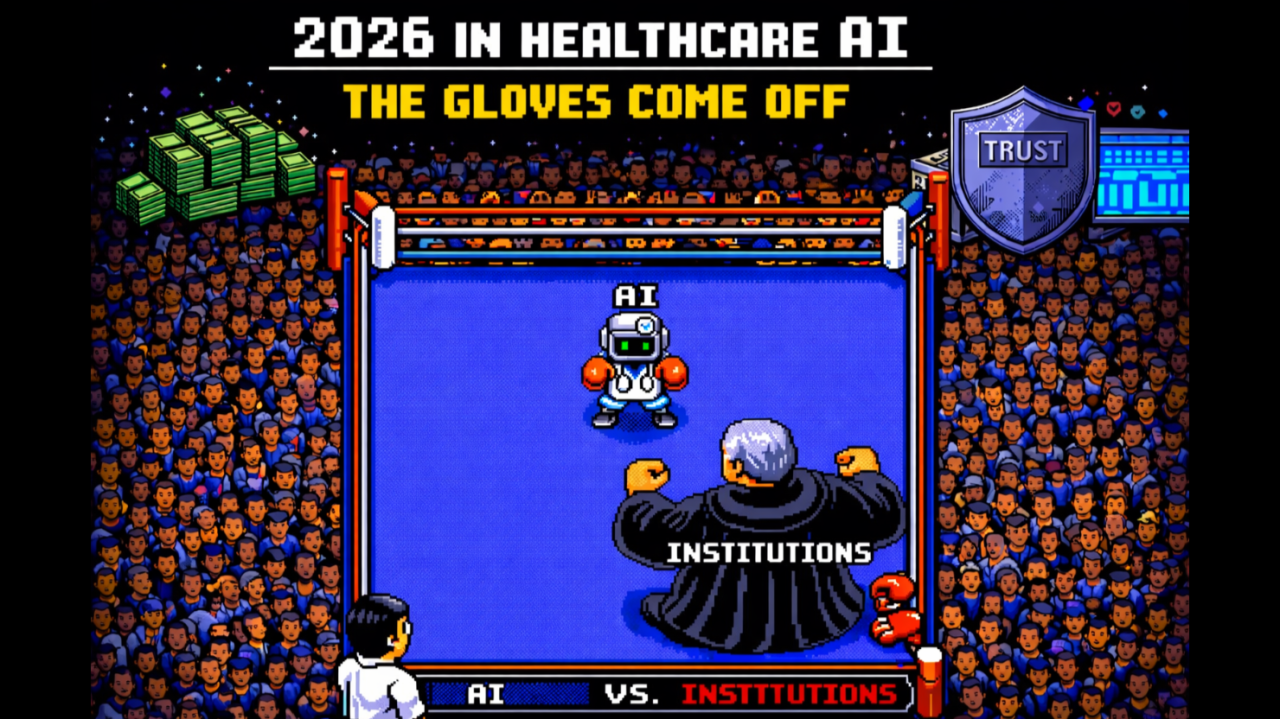
For years now, healthcare AI has been graded on potential. Participation trophies for showing up. Gold stars for “promising early results.” In 2026, that era ends.
Not because the technology suddenly matures into something magical — it won’t — but because AI finally collides with forces that don’t care about demos or pilot: law, liability, labor, regulation, trust, and power. These systems don’t grade on a curve. They don’t accept “we’re still evaluating” as an answer. They demand accountability when things go wrong.
Healthcare will be where that collision becomes unavoidable. When AI touches patient data, clinical judgment, and real harm, the conversation stops being abstract. Questions that were previously theoretical become urgent and expensive: Who’s responsible? Who’s liable? Who actually decides?
2026 is the year healthcare AI Stops Being Polite and Starts Getting Real. This is what that reckoning looks like when the gloves come off.
1️⃣ AI Regulation Stops Being a Policy Debate and Becomes a Legal War
In 2026, AI regulation leaves think tanks and lands in federal court. (This is the easiest prediction because we're already seeing the preface in late 2025 with Trump's Executive Order).
In 2026, a major case will test whether federal rules can override state-level AI regulations, including those governing healthcare. It’ll be about who gets to decide the rules when AI touches patient data, clinical judgment, and billions of dollars.
Healthcare becomes the test case because everyone will have a good argument that makes sense from their POV. States will argue they're protecting patients. The federal government (and Big Tech) will argue fragmentation is unworkable. Courts will be forced to answer the "who's regulating this thing" question but I think along the way they’ll actually also have to figure out an even tougher one:** legally what the hell is AI, even? **
2️⃣ The Patient Trust Singularity: Adjudication Becomes a Core Clinical (and Painful) Task
I think 2026 marks the Patient Trust Singularity: the moment when patients routinely trust their AI system’s medical judgment more than their clinician’s. Not because the AI is smarter but because it is more available, more confident, more validating, and never visibly uncertain. (If you doubt this trajectory, see the recent NYT coverage.)
By the end of 2026, patients will regularly arrive with AI-generated diagnoses, ranked differentials, and explicit test requests already in hand. We’re already seeing this in pockets. What changes is the scale, frequency, and credibility. This won’t be a printout from a fringe website or a late-night Google spiral. It’ll be a chat output on someone’s phone from a polished consumer AI tool—written in fluent medical language, mirroring the patient’s concerns perfectly, projecting calm authority.
Often, the patient will have already asked: “Write this in a way I can show my doctor so they’ll order the tests you say I need.”
The failure mode is subtle, and from where I sit as a physician, dangerously lacking context and insight. Take a patient who throws out their back and tells their personal AI assistant they “can’t walk.” The system responds empathetically and urgently: You need an emergent MRI. Go to the nearest ER now. Never mind that the patient means they’re in too much pain to walk, not neurologically unable to ambulate. By the time the clinician enters the room, the conclusion has already been reached and trusted. Any deviation from the script means the doctor is now the obstacle to getting the care the patient needs.
Real-life Dr. Walker — with my 15 minutes of allotted visit time — simply can’t compete with Dr. Claude, who has unlimited time, unlimited patience, unlimited empathy, and unlimited confidence and sycophancy. It never sighs. It never hedges. It never says, I’m not sure. In an era of medical mistrust and information overload, that combination is extraordinarily powerful. (When it comes to medical misinformation, I usually consider that level of confidence a red flag for snake oil. Many patients will interpret it as advocacy.)
If AI scribes and Epic's "Automated Response Technology" are already turning clinicians into editors of transcripts, the Patient Trust Singularity pushes doctors into an even more uncomfortable role: adjudicator. Umpire. Not just diagnosing and treating, but refereeing between an algorithm the patient already believes and a profession the patient is increasingly skeptical of.
I worry that the exam room becomes a contested, more directly hostile space for both humans in the room. Clinicians find themselves arguing with what feels like “the smartest doctor in the world” while trying to explain why a CT scan for every headache is not good medicine. Sometimes ChatGPT will be wrong. But sometimes it will be right. The latter cases will make headlines. The millions of times clinicians correctly say “no” will not.
The downstream effects are predictable and give me heartburn. Faced with this dynamic, clinicians will:
- Order tests they don’t believe are indicated, to preserve trust or satisfaction (remember, we decided that patient satisfaction should be rewarded financially!)
- Hold their ground, only to watch patients seek validation elsewhere—often via the growing direct-to-consumer testing ecosystem
- Some combo of 1 and 2, because sometimes Dr. Chatbot will be right, and will be helpful
- Or quietly leave clinical practice altogether
None of this is primarily about technology. It’s about trust, authority, and who patients believe is on their side. Right now I don't think that's anyone inside the healthcare system. The Patient Trust Singularity doesn’t replace doctors with AI. It places doctors in permanent conflict with it, while still holding them solely responsible for the outcome.
That is not a job clinicians signed up for.
3️⃣ We Get Not One, but TWO Worlds of AI Education
In 2026, we start to see AI training for clinicians and healthcare workers becoming standard. Health systems roll out policy modules on risk, compliance, and what not to do. These are, as always, legally prudent but clinically hollow as most training modules usually are.
Meanwhile, I think a parallel CME ecosystem explodes. Courses on effective prompting. Specialty-specific workflow playbooks. Practical guides to using AI for differential generation, documentation, and literature synthesis. Peer-led training that teaches clinicians how to actually use AI to think faster — not just how to avoid trouble.
This mirrors every other technology shift in medicine. Institutions teach compliance while fellow clinicians teach how to use tools to solve their own problems. We've seen this numerous times: ER docs figuring out how to use point-of-care ultrasound to diagnose and rule out better and faster; specialties using drugs off-label for new indications to help their patients. AI will be the same: cardiologists will help cardiologists use AI for cardiology. Pediatricians will help pediatricians use AI for peds.
(I will just beat the dead horse and remind everyone here that we trust clinicians to practice safely with literal lives. We already allow clinicians to prescribe drugs with black-box warnings — but we panic at the idea of them using a text generation model.)
4️⃣ Clinical AI Tools Compete for Legitimacy
Underneath the education wars, a different battle is brewing: purpose-built clinical AI tools competing for legitimacy.
Products like OpenEvidence, Glass Health, Vera, DocsGPT, and AMBOSS Lisa are positioning themselves as the "safer, better, more accurate" alternative to raw ChatGPT—citations, guardrails, medical-specific training. Whether they actually deliver on that promise is still getting hotly debated online and in academic circles. (Their growing usage is not.)
In 2026, we'll see new benchmarks and evaluation frameworks specifically for clinical generative AI, attempting to measure not just accuracy but reliability, transparency, and safety. (See the NOHARM preprint for thoughtful analysis on how these evaluation frameworks could work.) Alongside these benchmarks, look for frameworks that directly address the known limitations of generative AI: hallucinations, confidence without competence/sycophancy, or black-box reasoning that can't be audited. And perhaps more importantly, frameworks for handling ways where companies might try to cut corners, or drive toward the attention economy over clinical reliability and helpfulness.
This matters because the gap between "ChatGPT with a medical prompt" and "purpose-built clinical AI" may become a marketing war. Every tool will claim to be the trustworthy one— including the foundational models like Claude and ChatGPT themselves that the other tools are probably using under the hood. Awk-ward!
The companies that survive will be the ones who can actually prove their value to clinicians and to the lawyers and regulators and risk officers from Prediction #1 who are suddenly paying very close attention.
5️⃣ The First AI Malpractice Case Rests on Disagreement, Not Necessarily "Error"
In 2026, a lawsuit finally forces the issue everyone's been tap-dancing around: disagreement between AI and the doctor. (This will probably get accelerated by numbers 1 and 2 as well.)
AI recommended Test X, clinician declines, patient suffers harm. Or the inverse: clinician follows AI guidance against their own judgment and outcome is bad. Either path creates the same exposure and risk.
Once that question is asked in court, healthcare AI risk and liability stop being theoretical overnight.
(One more Nota Bene here: if Satya Nadella said tomorrow that Microsoft would even partially indemnify 10% of AI claims for health systems, I think the liability anxiety is so high that every health system in the world would move everything to Azure and make Microsoft billions. Mr. Nadella if you're reading this, I'd love a 1% cut please)
6️⃣ AI Scribes Aim for the EHR, Exposing Their Weaknesses
Some AI scribe companies decide documentation isn't the prize — it's just the entry point to an electronic health record. In 2026, a handful of them attempt to build AI-first EHRs (or maybe we actually see that Oracle’s product is not vaporware!). Imagine an EHR system where clinicians describe workflows in plain language and the interface configures itself. Templates on demand. Adaptive layouts. Workflows that aren't frozen in 2009.
I’ll say this ’til I’m blue in the face: I don’t do what a cardiologist does all day. I don’t even know what they do, or how they think about information, or how it should be represented on the screen. But I also don’t really know how other ER doctors want their information displayed, either. Do they think about things in the same way as me? Would they rather have vital signs at the top of the screen, or on the left side of the screen?
With AI they don’t have to choose. If the data is readily available, I can ask AI to make the exact interface I want. Not even one that’s built “for ER doctors, by ER doctors.” I can have one built “by Dr. Graham Walker, for Dr. Graham Walker.”
I mean, most of these ideas will still probably fail because EHR incumbents are too entrenched, and they’ve made switching costs intentionally too high.
But a few will succeed just enough to expose an uncomfortable truth: clinicians tolerate legacy EHRs not because they're good, but because there hasn't been a credible alternative. Once that illusion cracks, it doesn't un-crack. The toothpaste is already out of the tube.
The EHR incumbents will certainly respond. That’s the nice thing about competition. Maybe they do something crazy, like partner or acquire? (I know, I know, I already said it’s crazy.) But otherwise their reputations shift from "EHRs are hard to get right and configure perfectly” to "EHRs have been choosing not to evolve."
7️⃣ AI Starts Fixing Direct Primary Care's Scaling Problem
I love the idea of "primary care as a subscription model." In the same way that you want to have ongoing access to Netflix and pay a monthly fee, it makes sense to me to pay a doctor monthly for ongoing care. (And Americans love all you can eat!)
My biggest issue with DPC is the scaling. It's small patient panels (great for patients!) and high touch, no big billing infrastructure — but if every PCP switched to direct primary care, we'd be even shorter on PCPs than we already are. (To be fair, I also believe that the growing trend of DPC may actually drive a few more current-specialists toward pivoting back to primary care services, or a hybrid of primary and specialty care services, but only available as a DPC subscription to them.)
The challenge I see with DPC isn't the care itself, which is often really, really outstanding. It's everything around it that I'd imagine is limiting panel size: Inbox triage. Refill requests. Prior auths. Care coordination calls. Pre-visit chart review. The work that happens between visits— the work no one sees, no one measures, and no one technically pays for in an all-you-can-eat model — is what makes DPC panels have to stay small-ish. (Please DPC docs tear me to shreds in the comments if I’m way off base here.)
If AI can absorb that invisible labor, maybe the math finally starts to work? Not AI doing the medicine, but AI doing everything else, like the administrative scut that eats nights and weekends. The cognitive overhead that makes 400 patients feel like 800.
This could be the first real proof that DPC can scale without becoming “concierge medicine for the wealthy.” The doctor does the doctoring. The AI does the stuff that was never supposed to be the doctor's job in the first place. But this only works if AI removes friction — not if it becomes a buffer between doctor and patient, since that’s the whole point of DPC.
8️⃣ Physicians Finally Stop Waiting for Permission
By 2026, the physician-builder movement stops being a curiosity or a fluke and becomes a pattern.
Not because doctors suddenly want to be entrepreneurs — but because the gaps have become intolerable, and AI makes building solutions accessible on-demand. Health systems won't build workflow tools that respect clinical time. EHR vendors won't adapt fast enough. Public health institutions can't move at the speed of misinformation. Because AI-generated content will fill the trust vacuum faster than traditional authorities can respond (and down we go, the continued downward spiral of medical misinformation).
So some physicians will decide to just do it themselves.
Newsletters that bypass institutional comms systems. Prompt libraries shared peer-to-peer on Github or on Slack. Startups that sell to doctors first and ask health systems later. Public-facing voices that build credibility one post at a time because silence cedes ground to anti-science nonsense.
It probably won’t be all that coordinated. Doctors are highly tribal by specialty and love an in-group and an out-group. But it’ll be driven by frustration reaching critical mass. Some will build companies. Some will build audiences. Some will just build for themselves.
The common thread: they stopped waiting for someone else to fix it, because they doubt anyone else will or will care to.
(In full disclosure this is my lane and this one is probably some of my own ego about how I think the world should work.)
Conclusions
2026 is the year healthcare AI stops getting graded on potential.
No more extra credit for showing up. No more gold stars for “promising.” No more incomplete grades while we wait for consensus, clarity, or perfect policy. The test is already underway, and the answers matter.
AI doesn’t evolve in a vacuum. It collides this year with its more mature siblings that shape society and already have power and precedent. Plus sharper, more-entrenched teeth. Those forces don’t slow down, and they don’t accept “we weren’t ready” as a defense.
The organizations that have been coasting on “we’re still evaluating AI” won’t avoid that collision, they’ll just be ill-prepared for it.