Soooo, ha, um, I have a secret I’ve been keeping from you: I’m joining MDCalc full-time as its Head of AI.
I wish I could say that I rage-quit medicine or that I’ve got some incredibly juicy story to tell, but alas. There’s no reality show in my future. Nobody pushed me out. There wasn’t one terrible shift where I threw my stethoscope on the floor and yelled, “I’m done!”
The real story is both simpler and harder for me to explain.
I think we’re living through one of the most interesting moments medicine has seen in decades. AI is changing what is possible with medical knowledge, clinical decision-making, and the relationship between patients, physicians, and information. Some of what is coming will be wonderful, and gets talked about all the time. Some of it profoundly worries me, yet discussing it is viewed as alarmist, protectionist, or simply unpopular to say out loud. And a tremendous amount of what comes next hasn’t been decided yet.
I want to help decide it. I’m going to be a patient in this system too. So will my family and the people I care about. I want us to get this right.
A few years ago at MDCalc, we published The Physicians' Charter for Responsible AI, an attempt by a bunch of practicing doctors to articulate what we should expect from the AI being built for healthcare. AI has changed rather dramatically since 2023, so one of the things I want to do is revisit it. The technology has moved faster than our professional norms around it, and I think physicians and patients should have a much bigger voice in defining what we need and demand from AI — and what we shouldn’t be willing to give up in exchange for it.
Speaking of MDCalc…
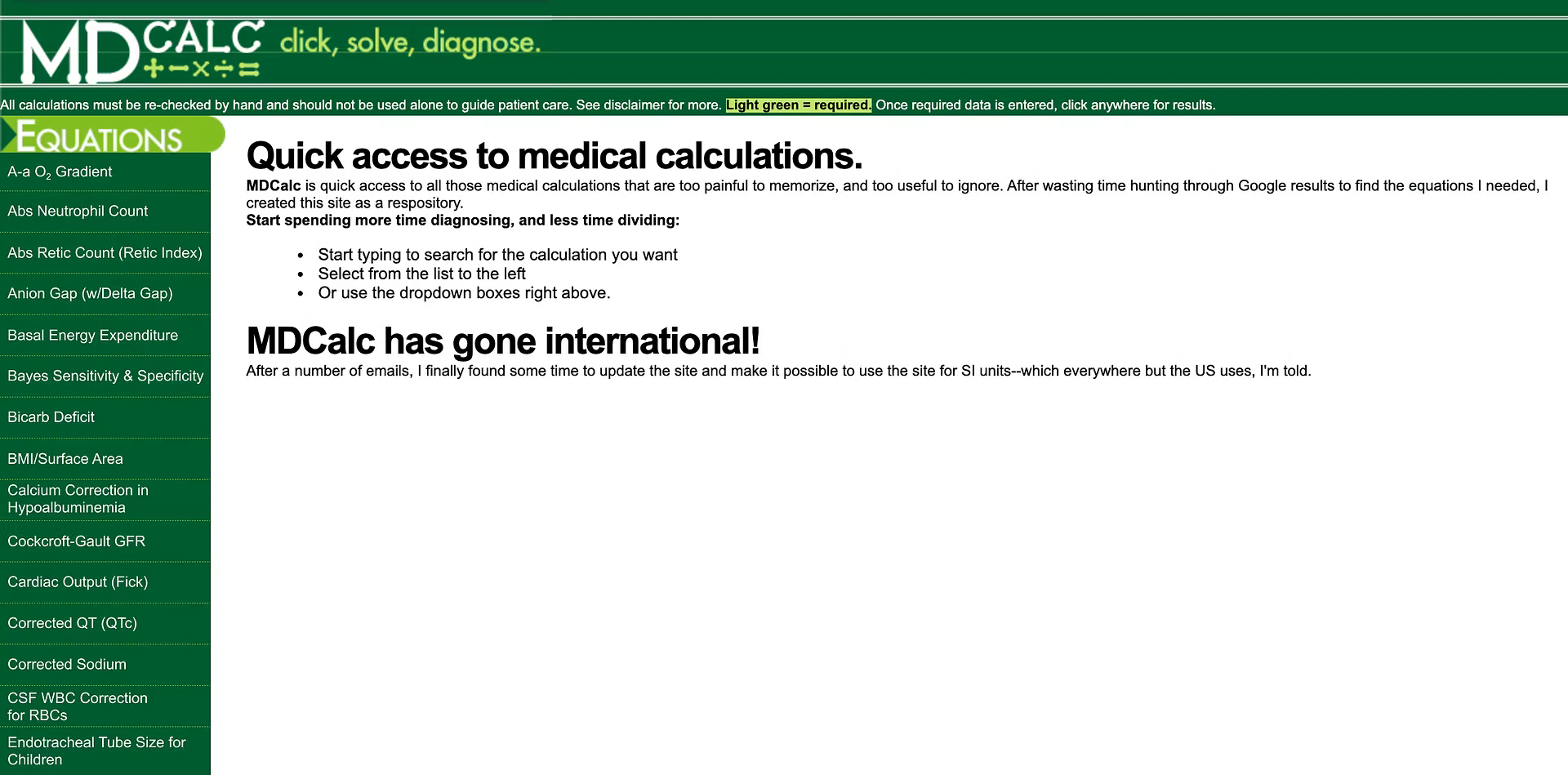
Circa 2005 MDCalc...
21 years ago, when I was a medical student, I started reading papers and turning them into interactive tools on a website for myself and other doctors. I thought it was ridiculous that useful medical knowledge could exist and still be so difficult to understand, access, and apply at the bedside.
That little webpage grew up to become MDCalc, especially thanks to the incredible dedication and partnership of my friend from residency, my co-founder and our brilliant CEO Dr. Joseph Habboushe, MD MBA who leads us. Millions of clinicians now use our website, app, or EHR integrations — a survey last year said it’s the second most broadly used clinical tool in the world after UpToDate! And somehow, twenty years later, I have the chance to come back full-time to the company I helped create and work on essentially the same problem at an entirely different scale:
How do we get trustworthy medical knowledge to the right person, in the right form, at the moment they need it?
Only now the possibilities are much bigger. Generative AI can interrogate evidence, synthesize enormous amounts of information, generate differential diagnoses, estimate risk, and help patients explore questions that previously required access to a physician. Predictive AI can build better models and offer better insights and more accurate prognostications to doctors and patients. AI in all forms can be really, really helpful. Sometimes it can also be really, really harmful. (Oops, not supposed to say that last part out loud.)
And no matter how much appropriate challenge and shade I throw toward JAMA commentaries claiming we’re already there, there is certainly signal in this new, powerful, amoral technology called large language models.
Medical knowledge is becoming abundant. But the human capacity to interpret it, contextualize it, and decide what actually matters isn’t. That gap is enormously interesting — and worrisome — to me.
The questions surrounding this are profound:
- What should physicians still own when machines can perform more of the tasks we were trained to perform?
- How do we distinguish an answer that sounds right from one we should actually trust?
- What happens when patients arrive with an AI opinion and ask their physician to adjudicate it?
- Can AI actually give doctors time back — or will healthcare simply use the efficiency to ask everyone to do even more with less?
That last question matters to me more than I think much of the AI conversation acknowledges, because physicians have been through a version of this before. We were told electronic health records were going to transform medicine: better information, safer care, more efficiency, more connectedness. Some of that happened. But I don’t know many physicians who would describe the EHR era as a technological revolution that made practicing medicine more humane.
And now here comes another technological revolution, only this one is arriving when the profession is already strained. Burnout is real. Physicians are questioning whether the sacrifices medicine demands are still worth making. Some doctors and nurses are cutting back or leaving. Some of the most talented people I know are asking whether they want their children to go into any one of the many professions that healthcare even offers.
AI could make medicine dramatically better to practice. It could take away work that never required a physician in the first place, give us better access to information, help us make better decisions, and create more capacity for the parts of medicine that actually require a human being. Or it could become the most powerful technology we’ve ever invented for asking fewer people to do even more work.
I worry that we’re treating physician attrition as if it’s just another workforce projection to manage rather than a warning about the profession itself. There is a world where we continue making medicine less attractive to practice, allow more people to leave, and then use AI to stretch whoever remains across an increasingly strained system. That might look like efficiency on a spreadsheet. I’m not sure it looks like better medicine.
We got a lot wrong about how technology was introduced into medicine the last time around. I don’t think physicians are interested in simply being told to trust the process again. Fool me twice, shame on us.
So yes: can we build technology that makes medicine a better profession to practice in? I want to work on that problem.
I miss you, dear Brian
There is another reason I’m willing to take the risk. Last year, my friend and colleague Brian Lin died unexpectedly. Brian was an emergency physician, an extraordinary teacher, and one of those people who quietly made everyone around him think a little harder about how to be a better doctor and human being. His death changed something in me.
Not in some cinematic, quit-your-job-and-move-to-Bali way, even though Hallmark and Hollywood teach you that’s what you’re supposed to do. For me, Brian’s death simply made the finiteness of all of this harder to ignore. There are things I want to try. There are risks I want to take despite my own crushing anxiety and the voice in my head telling me they’re impossible. And there is no guarantee I’ll get around to them... someday.
I’ve been becoming or being a physician since I was 18. I practiced emergency medicine for 18 years. I spent most of my career at The Permanente Medical Group, Inc., an organization and a group of people that profoundly shaped me as a physician and a leader, and whose model I completely believe in. Walking away from all of that isn’t one decision, and there isn’t one explanation.
So rather than pretend there is (and let’s be honest, this is already getting long), I’ve been writing about it.
I’m going to write about why I’m leaving emergency medicine, and how the bargain I thought I was making with my specialty changed over nearly two decades. I’m going to write about why I’m stepping away from clinical practice, which turns out to be a different and much more personal question. I’m going to write about why I’m leaving TPMG after spending such an important part of my career there, and about what it means to leave an institution and people you still deeply value.
And then I want to write about what I think medicine needs to become.
Some of those posts will be critical. Medicine has real problems, and pretending otherwise doesn’t serve anyone. But I don’t want this series to begin with what I’m leaving. I want to begin with what I’m going toward.
I’m returning to something I started twenty plus years ago, at a moment when the original mission feels more important than ever. Medicine is about to change enormously, and I’d rather help shape what comes next than watch it happen from the sidelines. I think most physicians want that, too.
As I said last week to hundreds of Australian physicians, I think we need lots of seats at a really big table. I need a pharmacist’s expertise to solve pharmacists’ problems. I need a pediatrician to solve pediatricians’ problems, because I don’t even know what many of them are. Nurses, patients, caregivers, specialists, generalists — the people actually doing and receiving the work need a hand in designing what comes next.
And MDCalc certainly doesn’t need to build all of it ourselves. One of the things I’m most excited about is finding great people and companies already building thoughtful, trustworthy AI and asking: what could we do together? There are researchers, clinicians, startups, health systems, and technology companies solving pieces of these problems extraordinarily well. I want MDCalc to be both a builder and a great partner — particularly when working together can get something useful and trustworthy into clinicians’ hands faster.
Generative AI makes something remarkable possible: we can increasingly build technology around those different people and their different needs instead of forcing everyone into the same workflow. But the technology doesn’t determine what we do with it. The incentives do. The institutions do. We do.
Whether AI-generated efficiency becomes more capacity for care or simply more work is a choice. Whether AI strengthens clinical judgment or gradually erodes it is a choice. Whether we use all of this new intelligence to make healthcare better for patients and the people caring for them is a choice.
A lot of those choices haven’t been made yet. That’s why I want to be there.
I’m excited. Also, a little terrified.
But why not go out on a limb? That’s where all the fruit is. 🍎