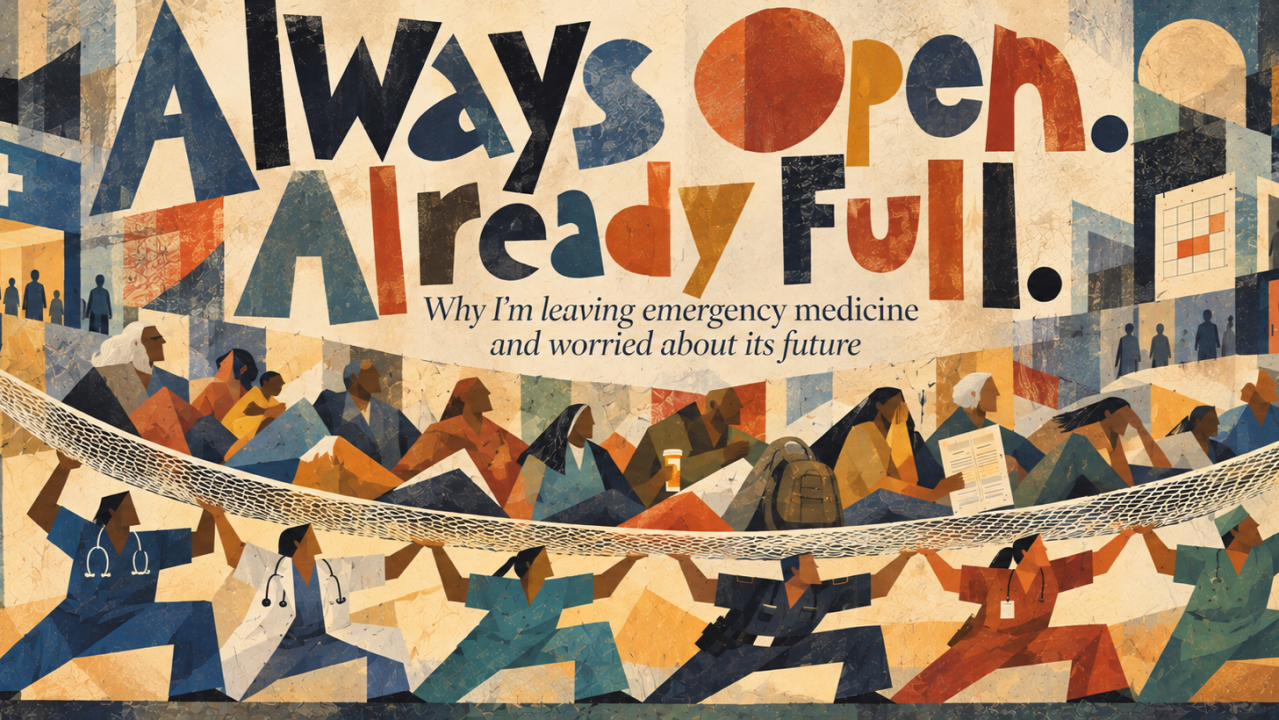
Why I'm leaving emergency medicine and worried about its future
“I was drunk last night and accidentally drank a bottle of Suave peach conditioner because I thought it was juice” is not a chapter in any medical textbook, but in emergency medicine, I’d better know what to do about that. (Yes, this was a real patient; yes, she was fine. Turns out, like many things, drinking conditioner is no match for the magic of the human body.)
I chose emergency medicine 20 years ago because I like solving problems. I like that in my specialty, I have to know a little of everything. I like that emergency medicine gets to the heart of the matter quickly, without the benefit of time or a pre-scheduled appointment. (Rapport? What a luxury!) I've honed my ability to read strangers within about five seconds of meeting them. Here's the patient. Something is wrong. Figure it out. Go!
I didn't choose it for the nights or weekends or holidays. Nobody does. I chose it for the bargain. In exchange for the chaos, you got to be useful. Immediately, directly, unambiguously. Sometimes (emphasis on the sometimes) you saved their life. Sometimes you just made a terrible night a little less terrible. Either way, the distance between "something is wrong" and "I helped" was remarkably short.
Drinking hair conditioner is a problem. A laceration is a problem. A heart attack is a problem. Problems have solutions. It took me years to notice how much of my job had quietly stopped being about fixing problems at all.
What I didn't understand when I chose this field is how much that bargain depended on the rest of the healthcare system working around us. I also didn't understand that being built the way we ER doctors are (adapt, roll with the punches, run towards the disaster, go faster, make it work) makes you extraordinarily useful to a system that is, itself, falling apart. And that usefulness that I so desperately desired from my medical career? It became something the system will a̶b̶use to its absolute limit.
The Helpers
One of the things I didn't anticipate when I chose emergency medicine was how much I would love the people who choose it. I am enormously proud to be an emergency physician, and I have spent my career surrounded by emergency nurses, pharmacists, techs, paramedics, respiratory therapists, clerks, social workers, and physicians who are, by far, the most extraordinary people I know.
We're a weird bunch. We're the people who hear, "Is there a doctor on the plane?" and stand up. We're the people who see someone collapse on the sidewalk and run up to them. Somewhere along the way, we trained ourselves not to assume somebody else will handle it, because we know that sometimes we are the somebody else. Mr. Rogers' mother told him to "look for the helpers." I've spent most of my adult life working with helpers. Can you imagine working with exclusively helpers at your job, every single day? What a privilege.
These are people who work while you are home on Christmas. And Thanksgiving, and their families' birthdays, because they know someone will need help on those days, too. They flip their bodies between days and nights to keep the ER running. They get screamed at, threatened, assaulted, coughed on, bled on, and then walk into the next room and introduce themselves to a stranger, doing their best to pretend none of it happened. They sit with a family on the worst day of their lives, and then someone in Room 12 needs something, so they go help them, too.
Much of the time, nobody remembers us. I routinely go upstairs to the ICU to check on patients whose lives we helped save the night before, and the patients have absolutely no idea who I am. (Of course they don't. They were critically ill.) Maybe they were unconscious, delirious, intubated, terrified, or surrounded by twenty people doing things to them at once. The night before, I was telling the nurse, "I don't know, Sarah, I think we fixed her! Let's get her up to the ICU before she looks too good for them!" Now I'm just some random guy standing at the foot of their bed.
That's emergency medicine. Sometimes, if we do our jobs perfectly, we disappear from the story. And that's okay. Nobody goes into emergency medicine expecting thank-you notes from unconscious people. There is something deeply but quietly satisfying about mattering to a stranger, whether they remember your name or not.
The Safety Net
Emergency medicine was always the safety net. Every emergency physician knows that going in. You’ll see genuine emergencies, near-emergencies, and plenty of things that could have waited until Monday: a kid with a cold, a sprained ankle, a medication refill. You make peace with that in residency. It was a tough pill to swallow for me, but eventually you stop asking people why their nine years of knee pain is an emergency today.
When I started in 2008, the exchange still felt right. I’d do the ER portion (fast assessment, stabilization, workup), then pass the patient to a system that carried the ball downfield. The handoff worked. The patient left with a plan that had legs. Somewhere along the way, though, the system started fumbling passes left and right. Butterfingers.
Every other part of healthcare has a release valve. Or at least a “tank is empty” gauge. When the primary care clinic fills its schedule? Sorry, no more visits today, call back next week. (Sure, you can shorten appointments, but a limit still exists.) The specialist books out six months. The urgent care stops taking patients at 6pm. Those valves always existed, but our population is older and more complicated now, and everything fills up much faster. So what’s left? Your local ER, if Medicaid cuts don't kill it. In 2008, the year I started, Americans made about 124 million ER visits. By 2022, it was 155 million. Over roughly the same stretch, one large study of commercially insured adults found primary care visits fell by nearly a quarter, and almost half of those adults didn't see a primary care doctor at all in a given year. The front door got narrower. Ours stayed wide open.
The ER has no pop-off valve. Our gas tank never reaches E. We stay open when even Waffle House closes. The federal EMTALA law helped make my specialty what it is: if you show up, we don’t first decide whether you’re worthy of care or whether you can afford it. We’re tremendously proud of being one of the only places in American healthcare that treats patients that way.
But there is something bizarre about where America has chosen to draw that line. (By the way, we passed EMTALA in 1986, and haven’t fundamentally rethought it since.) If you can’t afford your insulin, our system may or may not figure out how to get it to you. But if you go into diabetic ketoacidosis because you couldn’t get it? Hey, come on in, the ER’s open! We have an emergency physician, nurses, pharmacists, laboratory technicians, an ICU bed, IV insulin, hourly blood draws, and an astonishing amount of medical infrastructure ready to save your life. And don't get me wrong: you deserve saving. But it seems plain stupid to me for us to pay for all of that but not for the medicine that would prevent it in the first place.
Emergency medicine increasingly sits at the end of contradictions like this every single day. When primary care becomes inaccessible, specialist waits stretch to months, psychiatric beds disappear, community resources run out, or outpatient care becomes too expensive or difficult to navigate, the people don’t disappear. The need rolls downhill, and the emergency department has its lights on and its doors open at the bottom of the hill. (Ironically, my hospital in San Francisco sits at the top of one.)
Infinite demand. No exit. I think Sartre would laugh. Most days that’s all I can do, too.
The Department of Last Resort
Which brings me to what many emergency physicians have started calling our actual specialty: availablist. I am available. That is my primary qualification for an enormous portion of what walks through my doors.
A patient has had a rash for six months. It’s not dangerous. It’s not changing. What he needs is a dermatologist, but the next appointment is two months away, and he doesn’t want to wait two months to find out what the thing on his arm is. So he comes to me.
I’ll see him because he’s a person with a concern and I’m the doctor who’s available. But I’m not a dermatologist. I can tell him it doesn’t look infected, or obviously dangerous, or cancerous. I suggest something safe to try, and tell him to keep the dermatology appointment he already has. What I cannot do is manufacture specialty access that doesn’t exist. He might be displeased with my candor, but from his perspective, he can get a $1,200 iPhone delivered to his doorstep in six hours, so why can’t he get his rash looked at properly? I genuinely get it. He’s navigating the healthcare system as it actually exists, not as anyone intended it. His choice makes complete sense given his options.
Which also makes us the face of everything that didn't happen upstream. Scroll through social media or the online reviews for any ER and you'll see it: seven-hour waits, a doctor who "didn't even do anything," a bill for being told to follow up with a specialist. The patient who waited seven hours isn't angry at the bed-management meeting, or the insurer that denied his MRI, or the clinic that never called him back. He can't see any of those. He can see me.
We've spent decades teaching people that the ER is the one place in American healthcare that's always open, and for a lot of them, it's become the only door. So they bring us everything, and then they're frustrated when an emergency department can't do what a specialist would. It's like going to a cardiologist about your knee: you'll be seen by someone smart, but you're not seeing the right doctor for the problem. The difference is that nobody makes you choose between a cardiologist and nothing. When you're the only part of the system still answering the door, you're also the only one left to yell at.
And increasingly, what rolls downhill isn’t even a medical (meaning: requires a medical doctor) problem. Someone is homeless. Someone’s family can no longer care for them due to dementia and our aging population. Someone needs inpatient psychiatry and there isn’t a bed. Someone needs addiction treatment, a social worker, a dentist, a caregiver, or simply somewhere safe to be tonight. Those are real human needs — often desperate ones — but once someone crosses the threshold of an emergency department, we have a remarkable tendency to turn those needs into “medical” problems, only because healthcare is the infrastructure we fund and promote with any emphasis these days.
(As a taxpayer, this seems insane to me. I’m not trained for it, I’m not good at it, and you’re paying ER prices for it. I can intubate someone and figure out whether the lady who drank peach conditioner is going to be okay. I cannot create an apartment. I cannot create a caregiver. I cannot manufacture a psychiatric bed.)
Yet somehow we’ve ended up using some of the most expensive people, buildings, and technology in America as fallback social-services infrastructure. Maybe part of the reason is that healthcare has become so spectacularly expensive that we’ve started assuming it had better take care of everything. We’re paying how much for healthcare? Fine. “Let healthcare deal with it.” Except spending more money on medicine doesn’t make every human problem a medical problem, and doesn’t solve society’s woes, either.
Making It Work
And so we make it work. I stitch people up in hallways, their lacerations on display to anyone who walks by. Not occasionally: routinely. The rooms we used to use for lacerations are full of patients waiting for inpatient beds that don't exist yet.
"Inpatient boarding," where admitted patients sit in the ER and take up ER beds, may be the purest example of what changed. I can diagnose the pneumonia, recognize early sepsis, call the hospitalist, and complete every part of the job emergency medicine trained me to do. And then… the patient stays with me. Now the emergency department is also an inpatient ward, except the ward is made of hallway stretchers and wasn't designed, staffed, or built to function like one. "Upstairs," there are actual rules. Patients sit in rooms and lie in beds. The lights go off at night. In the ER, fluorescent lights buzz 24/7 and ambulances keep pulling in. Nothing pauses just because of something as silly and unnecessary as physically available space.
So we adapt. The waiting room fills; we go faster. The beds fill; we board. We find another chair, another monitor, another patch of hallway. During the 2022 COVID-plus-mpox wave, we actually turned our waiting room into more patient spaces. I did an anal exam and diagnosed a patient with mpox behind a curtain and a sheet in our makeshift "waiting room care area."
We will do anything, for anyone, at any time. No psychiatrist? We'll manage the psychiatric patient. No social worker tonight? We'll call the family ourselves and try to assemble a discharge plan. No clinic will take them because they're uninsured, or missed their appointment? We'll bridge the prescription. We do it — sometimes begrudgingly — because a) the alternative is letting down the person standing in front of us, b) we know that the rest of the system is broken and shitty and it's not the patient's fault, and c) we need room at the inn for the next emergency that's about to show up.
Our scrappiness is one of the things I love most about emergency people. It's also what worries me most. Because the reward for making the impossible work is that tomorrow, the impossible becomes the expectation.
Hospitals talk about "the emergency department absorbing volume" or "the ER adapting," as though a department can absorb anything. It can't. The nurse takes another patient. The tech finds another stretcher. The pharmacist covers another emergency. The physician makes another consequential decision a little faster than they wanted to.
The system doesn't absorb dysfunction. People do.
And we've quietly built much of American healthcare on the assumption that these particular people will always say yes.
Problems and Dilemmas
The patients themselves have become more complicated since I signed up for this specialty, too. Here's how I know: since med school, I've had a habit of asking older patients various questions about their lives. What's been the biggest change in your lifetime? What's the secret to living a long life? Mostly, I get a good story and a laugh. But the habit has made me acutely aware of how much more often I ask. In residency it was a few times a year. Recently, every shift includes a patient over 90, if not several.
A 35-year-old with dizziness and a 92-year-old with dizziness share a chief complaint, but they are not remotely the same problem. The 92-year-old may have fifteen medications, a dozen diagnoses, kidney disease, heart failure, dementia, an exhausted caregiver, no clear baseline, and a goals-of-care conversation nobody has gotten around to having. Start looking and you will usually find something wrong. They're 92.
My patients' social situations got harder, too: more patients with nowhere to go after discharge, more without a primary care physician, more for whom the plan I construct over four hours falls apart the moment they leave... because the infrastructure needed to support it only exists Monday through Friday from 9 to 5, while my patients inconveniently insist on getting sick 24/7/365. None of this means these patients matter less. A frail 90-year-old whose family can no longer safely care for her has an enormous problem, far more consequential to her life than a laceration I can repair in twenty minutes. But it isn't one I can fix in an emergency department.
A problem has a solution. Emergency medicine was built around problems, and it is exceptionally good at them. Drinking peach conditioner is a problem. The six-month rash with no dermatologist available is something else: a dilemma. Dilemmas are managed, not resolved. They are chronic, complex, and structural.
The dilemmas aren't less important. Often they're more. They're just poorly matched to the tool (an ER doctor in an ER) we're using on them. More and more, I wasn't being asked to solve anything. I was being asked to contain it.
The Emotional Math
Emergency medicine has spectacular highs. The great save. The diagnosis nobody else caught. The moment a set of findings that looked unrelated suddenly tells a single story, and you act on it, and it matters. I have literally shouted, “Holy shit, I think this is Henoch-Schönlein purpura!” as if I’d found a diamond in the rough. You could practically hear the umlaut in my voice.
EM always had terrible lows, too. A child you couldn’t save. The diagnosis you missed. The family conversation you replayed on the drive home. Those were part of the bargain, and some stay with you forever. But somewhere along the way, the emotional math changed for me, too. The highs came less often, and even when they came, they didn’t hit quite as high. Meanwhile, the lows multiplied, mostly mundane ones: another hallway patient, another impossible discharge, another person I couldn’t give what they needed, another perfectly healthy patient whose employer required a “well note” before letting them return to work. (Yes, this is a thing; I’ve written hundreds of “Employee may go back to work because they literally have no symptoms” notes demanded by employers.)
None of these alone would make someone leave a career. But I do think it’s death by a thousand paper cuts.
The peaks got lower. The valleys got wider. Eventually I noticed I was spending a lot more of my life down there, and I had to ask whether the bargain still made sense.
“Congratulations”
When I told my group I was leaving clinical practice, I expected surprise, some sadness (I was in tears), and questions. What I heard instead, over and over, was “Congratulations.” Sometimes it was, “Wow, I’m jealous.” More than once, the sentiment was basically: You escaped.
I can’t stop thinking about that, because these are the people I was talking about at the beginning. The helpers.
And when one of us said he was leaving, their instinct was to congratulate him for getting out of the field.
I’ve heard versions of the same thing outside my own department. I know emergency physicians at some of the country’s best-known academic centers who trained there, built their careers there, and now won’t work there because they think the conditions are unsafe for patients and a risk to their licenses. These aren’t people who couldn’t handle emergency medicine. They’re exactly the people I would want taking care of me.
Lots of emergency physicians I know are looking for ways to spend less time at the bedside: administration, informatics, consulting, industry, anything that lets them keep one foot in medicine while putting a little less of their body and mind into the emergency department.
I should be honest: I’m one of them. I’m leaving the bedside for a full-time job in my medical technology company, and I know exactly how that sounds in an essay worried about people leaving. I’m not an exception to what I’m describing. I’m a data point. When the people who love this specialty most start building exits, that tells you something about the conditions, not the people.
And it should worry us, because emergency medicine needs extraordinary people. We’re asking the next generation to manage chaos, make consequential decisions in minutes, recognize who's quietly dying in the corner despite everything looking normal, and know what to do when somebody asks for a doctor on the plane. I legitimately think this is our 2026 sales pitch:
- “Come board admitted patients in hallways!”
- “Suture people while apologizing for the lack of privacy and dignity!”
- “Absorb every failure elsewhere in healthcare and society, while other specialties dunk on your incompetence from afar!”
Thirty physicians in my group aren’t a scientific sample, and neither are the hundreds of colleagues I saw last week at our annual emergency medicine convention. But I know what they all sound like. They don’t sound like people who stopped caring about emergency medicine. They sound like people who care deeply about it and aren’t sure how long they can keep doing it this way.
A specialty is in trouble when leaving it starts to look like success. That scares me more than any workforce projection ever could.
What Emergency Medicine Needs
I watch The Pitt because it treats people like me with enormous affection while showing the chaos, the gallows humor, and the absurdity, and that’s the spirit I’m trying to write this in, too. I’m proud of the physician that emergency medicine has made me, and I’m proud of every person I worked alongside who kept showing up. These are my people. Maybe that’s exactly why I feel obligated to write all of this out: caring about emergency medicine doesn’t mean pretending everything is okay. It requires being willing to say when something isn’t.
Emergency medicine was built to be the safety net. But a safety net works because it catches the exceptions. If dozens of people are falling off the tightrope, that's no longer a safety net. That's just how you get down.
None of this is the fault of the primary care physician whose schedule is full, the hospitalist with no beds, the psychiatrist searching for placement, or the dermatologist booked two months out. They're working just as hard, responding mostly rationally to the same broken system. But while the people inside healthcare keep compensating for what doesn't work, the structures around them have remarkably little reason to change.
Companies keep making money. Policymakers keep postponing hard choices. Regulators keep tweaking around the edges. And the system keeps functioning juuuust well enough, because somewhere downstream there's still a department that can't close, full of people who will figure something out.
The obvious answer is to stop making it work. But the helpers can't be the ones to stop. The only lever they hold is saying no... and "no" lands on the patient in Room 12, never on the system that sent her there.
So they don't say no. They leave. They realize they can make the same amount of money (or more), with a less hectic schedule, and in a less chaotic environment. Sometimes they exit all at once; during COVID, I watched hundreds of years of emergency nursing experience walk out of my department in about 18 months. More often, it's slow and quiet, one at a time. Into administration, the PACU, pre-op, the clinic. Into industry, or part-time schedules. And on the way out, their colleagues congratulated them, too.
I don't want the next generation of helpers to inherit a system whose primary strategy is their willingness to sacrifice more of themselves. I've done that. It doesn't work. I want them to get what I got from this specialty: the absurdity, the camaraderie, the privilege of being useful when somebody desperately needs you, and the occasional diagnosis that makes you shout the name of a German vasculitis from across the department.
I chose emergency medicine because I like solving problems. What we have now isn't one. It's a dilemma. And dilemmas don't get solved at 2am. They get handed to whoever happens to be there.
For now, that's still somebody good. Somebody trained to spot the one person dying in a waiting room full of people who aren't. Somebody who has traded their nights, their holidays, and more birthdays than they can count, because the stranger in front of them mattered more.
But we're burning through those people faster than we can replace them. EMTALA guarantees the doors will be open at 2am. It can't guarantee there'll still be someone behind them who knows what they're doing, will give up a night's sleep to do it, and still gives a shit.
Always open. Already full.
Eventually, empty.
This is part 3 in my series about changing my work and relationship with medicine. 2 more to go!
Part 1: Back to Where I Started... 21 Years Later
Part 2: What Do You Mean by Meaning?